After 32 seasons, Cops — a reality television show once described as a “one-celled amoeba” by co-creator Stephen Chao — has been cancelled by Paramount.
On June 9, a Paramount Network spokesperson made a no-frills statement regarding the cancellation to the New York Times. “Cops’ is not on the Paramount Network and we don’t have any current or future plans for it to return,” they said.
Even though Paramount officials did not elaborate on their reasoning for the cancellation, the recent resurgence of the Black Lives Matter movement and the global protests over George Floyd’s death make a partnership with a show like Cops morally repugnant and potentially bad for Paramount Network’s evolving brand. As evidence, on June 1, Paramount and other Viacom channels went dark for eight minutes and 46 seconds to commemorate the amount of time that former Minneapolis police officer Derek Chauvin had his knee on Floyd’s neck.
This is not the first time that Cops has been cancelled. In 2013, the Fox network dropped the show upon the conclusion of its 25th season. Racial justice advocate group Color of Change had been pressuring the network to cancel the show and created a petition that received over 35,000 signatures. “With its history of dehumanizing and racially inflammatory portrayals of people of color, Cops paints a damaging and distorted portrait of crime and the criminal justice system,” Color of Change claimed in an excerpt from their petition.
Cops was immediately acquired by Viacom cable channel Spike TV in 2013 for its 26th season. Maybe Spike TV would work with Cops’ production company, Langley Productions, to update the show’s format to be more commensurate with the public’s increasing calls for racial justice and police oversight?
Nope.
It was business as usual. Then-president of Spike TV, Kevin Kay, in an interview with TV Guide, made it clear that Spike TV had no plans to meddle with the show. “We told them (Langley Productions), ‘You guys know this better than we do.’ It’s perfect, we have a tremendous amount of trust,” Kay said. Kay later stepped down as president of the Paramount Network (formerly Spike TV) during Viacom’s consolidation in October 2018.
This tone-deaf level of hands-off management from Spike TV invited Cops’ seven-year slide into irrelevancy. Had there been any introspection and objective thinking then, the show might have implemented some critical adjustments that could have countered the public’s increasingly negative perception of police behavior. Instead, they doubled down on their original, lurid formula of heavily edited, seven-minute segments — where the good guys always get the backstory-less bad boys off the street.
They might have gotten away with it, too, if it hadn’t been for those meddling kids and their cell phones.
Cell phones with built-in video cameras.
Since Cops switched networks in 2013, social media has been inundated with material from amateur videographers. The rise of public platforms like YouTube ushered in an era where content trumps production values. Just about any stunt or mishap can be viewed on demand these days — including the actions of abusive police officers.
All of a sudden, police shows like Cops, and its younger, hotter cousin, Live PD, began losing control of their sacred narrative — that police officers are perennially competent professionals, capably dealing with the worst society has to offer. With the entire planet now able to witness a seemingly endless series of unedited negligent and violent police incidents, a show like Cops seems anachronistic and disingenuous.
Cops raison d’être was to broadcast a 22-minute pro-law enforcement commercial and recruitment tool every Saturday evening. Public relations-improving propaganda is what Langley Productions provided to troubled police agencies for access to their officers and hardware in lieu of any financial compensation. As Cops allowed each department to approve everything that was to go on the air, these agencies had little to lose by allowing the show to film in their cities. With this editorial control, each police department could dictate their own version of reality.
Until now.
Over three decades, Cops provided a weekly justification for Nixon and Reagan’s “war on drugs” and perpetuated rock-bottom expectations of minority groups — often showcasing and making light of people who are struggling with addiction and neglect.
In a way, Cops continued the work of the Jim Crow laws that allowed even the poorest whites to feel superior to people of color.
Langley Production’s “one-celled amoeba” did not evolve and adapt to the prevailing environmental conditions, and now it’s extinct.
A Unique Problem and a Unique Opportunity
On June 8, the Los Angeles Times published an opinion piece by screenwriter John Ridley titled “Hey, HBO, ‘Gone With the Wind’ romanticizes the horrors of slavery. Take it off your platform for now.”
The next evening, HBO Max did just that.
Whether this was a coincidence, a coordinated effort or a capitulation is irrelevant. What matters is that this is a bona fide example of anti-racism on WarnerMedia’s part. A statement on the company’s website includes a possible explanation for the decision. “Like many companies, we donate to partner organizations and programs engaged in social justice work. We write checks and yet racial injustice persists. This moment teaches us that money is only a part of the solution.”
According to Ridley — who wrote the screenplay for “12 Years a Slave” — “Gone With the Wind” is its own unique problem. “It is a film that, when it is not ignoring the horrors of slavery, pauses only to perpetuate some of the most painful stereotypes of people of color,” he wrote in his op-ed.
Based on the public’s reaction, you would think HBO Max had staged a book burning. People quoting Orwell and making accusations of “virtue signaling” is a sure sign that much of the outrage is coming from those who only skim headlines and make knee-jerk assumptions. What WarnerMedia is doing is not censorship — unlike Disney’s controversial decision in 1969 to edit the “Sunflower” character out of the “Pastoral Symphony” scene in “Fantasia.”
WarnerMedia has made it clear that they are not meddling with the film’s content. “… so when we return the film to HBO Max, it will return with a discussion of its historical context and a denouncement of those very depictions, but will be presented as it was originally created, because to do otherwise would be the same as claiming these prejudices never existed,” said an HBO Max spokesperson in an interview with The Verge.
Dana Harris-Bridson, Editor in Chief of film industry news website IndieWire agrees with WarnerMedia’s decision. “In terms of taking it down and giving context to it, I think it’s entirely appropriate. To me it’s no different than NASCAR saying we’re not going to allow the Confederate flag. When you start taking sides like that, those who don’t take sides are going to stand out in sharp relief,” she said.
No ones’ First Amendment rights are being trampled here. It is perfectly within WarnerMedia’s purview to temporarily (or permanently) withdraw that title from the HBO Max platform. They didn’t remove it from Earth. In fact, Gone With the Wind became an Amazon best seller the day after it was removed, possibly due to the Streisand Effect — a societal reaction to the perception of having something taken away from it. As of this writing, there are 3,658 copies of the film for sale on eBay. It’s available.
Adding contextual content to a film of Gone With the Wind’s stature is an original move that will likely generate conversation about racial inequalities in America’s past and present. Meanwhile, the highly controversial Civil War epic “The Birth of a Nation” is currently viewable on a number of platforms with no disclaimer at all, despite its depiction of the Ku Klux Klan as heroic and African-Americans (some being white actors in blackface) as sexually aggressive, subservient predators.
Does this stop with Gone With the Wind? Given a long enough timeline, just about any film could possess some culturally objectionable component, and many do for a number of reasons. The war propaganda in The Green Berets, the glorification of date rape in Revenge of the Nerds, the negative depiction of Native Americans in westerns.
Is there enough time, money and willpower to address every culpable project in the Internet Movie Database’s 6.5 million titles? Of course not, but there should be some case-by-case efforts made to provide context to some of the larger offenders. Ridley has acknowledged that there is a difference.
“I would ask that all content providers look at their libraries and make a good-faith effort to separate programming that might be lacking in its representation from that which is blatant in its demonization,” Ridley writes.
Harris-Bridson believes Gone With the Wind was such a special case. “It’s the most popular movie in history in terms of box office. It has as big of a target on its back as anything. I wouldn’t be surprised if someone isn’t going through the catalog (WarnerMedia’s) right now to flag other potential candidates and figure out what will need addressing,” she said.
One of the only upsides to the COVID-19 pandemic is that it has hit the world’s pause button and allowed us to reevaluate some status quos. The societal station wagon is not going 70 mph, making this moment a good time to tinker under the hood and change a tire or two. Providing contextualization to a classic like Gone With the Wind is just one example. Difficult subjects like racial inequalities in both society and business, police reform, education, climate change — are all on the table now.
At the beginning of the workday on any film set, the first thing heard is, “we’re in, we’re in!” It’s the production world’s equivalent of a factory whistle. Thousands of furloughed television commercial workers — including yours truly — yearn to hear this again. It’s time we got back to work.
Commercials tend to pay more than other types of projects. There’s a reason for this. If they didn’t, no one would agree to work on them. The days are fast-paced and can run anywhere from 10-18 hours long. They often include multiple locations, cramped and uncomfortable conditions, temperamental directors, nitpicky clients and a daily to-do list that is often the stuff of fantasy.
Not anymore.
For commercial production to be successful in the age of COVID-19, ad campaigns will need to be designed from scratch to reflect the limitations brought about by film crews and actors who are having to potentially work alongside the coronavirus.
“The creative needs to match the reality of what we can do. It’s going to need to be one location with half the crew size we’re accustomed to. I have one client that I work with every year. I told him that whatever y’all come up with needs to be one or two actors in one location, with no extras,” says Christopher Rogers, an Austin-based production supervisor.
I won’t miss the extras, but they want us to halve the crew size, now? The last commercial I worked on had over 40 people working and we barely managed to get everything done by sundown. Sweden’s COVID-19 filming guidelines estimate that the new workflows and smaller crew sizes “will cause a small decrease in productivity. We estimate this at about 10%.”
This is a hilarious prediction with which production company owner Ashley Bergeron-Ford disagrees. “I’m thinking more of a 30 to 40% increase. 12-hour shoot days — ain’t happening anymore. Not until we have a vaccine,” she says. Rogers concurs with this. “It’s going to take more time to get things done; we’re going to have to manage our clients expectations,” he said.
This is good news for beleaguered crew members, but I suspect these new constraints will introduce a few problems.
Time is the most valuable commodity on any film set. Adding a day or two to a project’s schedule, along with the new medical personnel and additional production assistants, is going to be expensive.
Rogers isn’t terribly troubled by this. “You are no longer going to have 15 agency and client personnel flying in. That can cost 20 or 30 grand on a shoot. You’re no longer going to have gift bags. I think you’re just moving your money around,” he says.
Virtualization of the clients will be nice but accommodating the on-set director while navigating 10-20 different Zoom participants’ “thoughts” is possibly going to bog things down. “I have an entire page written about patience,” says producer David Wolfson. “They are going to have to understand that it’s just not normal anymore.”
Rogers believes that enhanced pre-production planning will be essential for success. “They’re going to have to make up their minds on all sorts of things beforehand: props, wardrobe, set dressing — they can’t decide on the day,” says Rogers. Personally, I’m a little skeptical of this claim. I recall working on a spot for the Container Store last year where it took over two hours to roll the first take due to 15 people disagreeing about how many shoes to place in a closet.
Assorted growing pains with the workflow aside, when the Governor’s Strike Force to Open Texas finally allows us back in, this new normal looks to be way better for us workers. At least, until there’s a vaccine.
EYES WIDE OPEN
Texas filmmaker Clint Bentley
“Everyone may know of your idea; even though, it will never be as it real as you thought.” ― Alan Maiccon
Independent filmmaking is often a dubious and quixotic endeavor, better-suited for chess players than first-person shooters. Truly, a get-poor-quick scheme that only promises seemingly endless pitfalls and compromises. Producing a finished piece requires a manic tenacity and a visceral connection to the concept of delayed gratification. It involves the planting of many seeds with the knowledge that it may take months or years to see anything come to fruition.
Clint Bentley, a 34-year-old Dallas-based filmmaker, understands this.
Having grown up on a working cattle ranch near Daytona Beach, Florida, Bentley was often alone with his thoughts and his chores. Performing difficult work that might not show results for extended periods of time. This arduous environment developed a work ethic and mindset that has become a valuable asset to his current career.
The Bentley family back then didn’t have cable, so rented movies were the main form of entertainment in their doublewide. There were no friends nearby, so free time was often spent alone in wooded areas that were peppered with old and weathered abandoned structures. Plenty of fodder for a young person’s imagination.
An English major in college, Bentley took a hiatus from his studies to try his hand as a singer-songwriter, living in friend’s stairwell in New York. It proved to be a short-lived digression — Bentley quickly realized that particular brass ring was safely out of his reach. His time in NYC wasn’t entirely a bust — while there, he was exposed to foreign films that inspired him and expanded his worldview.
Bentley returned to Stetson University with this new appreciation for film to finish his Literature degree. He wanted to make a documentary about the U.S. – Mexico border and applied for and received a SURE grant from the school to finance it. As the grant was $2500, it basically paid for a modest camera, some travel expenses and little else. It was titled, “Boulders Fall to Each.”
After college, Bentley took a stab at making some short films, one was titled “I’ll Remember Everything”, which he describes as a “pretentious film with a pretentious title.” But these early forays provided some personal and professional calibration. “What kind of stuff gets you off, and what kind of stuff do you not care about? There’s only one way to find that out, and that’s by doing it. Everybody’s a perfect filmmaker when they are sitting around dissecting other people’s movies,” said Bentley.
Bentley and Kwedar
In 2010, Bentley’s parents decided to move to Texas. Bentley himself was toying with relocating to Austin or Paris when he met his now-wife Rachel. She introduced him to a guy named Greg Kwedar that she went to college with at Texas A&M. Kwedar was a filmmaker who had been doing some things at the border as well.
Bentley and Kwedar hit it off and began collaborating on a feature-length film about the Border Patrol called “Transpecos”. It would only take them six years to get it made.
The script for “Transpecos” went through several phases over the years, with the final shooting version being a good deal more conservative in scope versus one of the earlier drafts, due to time and financial constraints.
While fundraising for “Transpecos”, Bentley and Kwedar decided to make a short film called “Dakota” — a similarly-themed proof of concept. Making “Dakota” allowed them to get a better feel for the logistical hurdles to come and provided a test drive for their new roles: Kwedar as director and Bentley as producer.
“Transpecos” Call Sheet Day 1 of 17
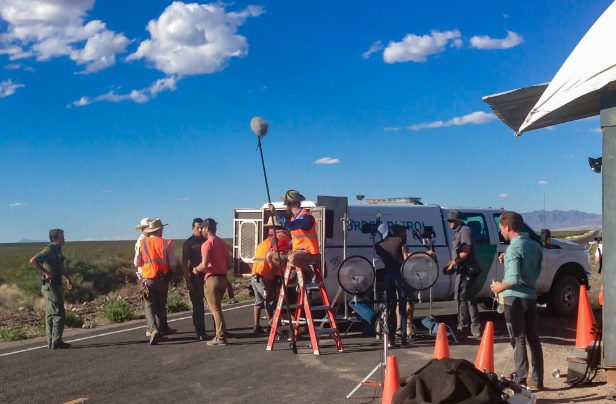
Production on “Transpecos” finally began on June 8, 2015. A mere 17 days were allocated to shoot the entire film, most of which was set in a sweltering desert area outside of Deming, New Mexico. The average temperature was 112 degrees. Some crew member’s shoes were melting on the pavement during production.
“Transpecos” wound up being a hit on the 2016 festival circuit, including the prestigious South by Southwest Film Festival, where it won the audience award for best narrative feature. It was then picked up for distribution by Samuel Goldwyn Films. Bentley and Kwedar were chosen among the 25 screenwriters to watch in 2017 by MovieMaker Magazine. Bentley was all set.
Then his alarm clock went off.
“Transpecos” during production
“I thought it would be more successful than it was. I thought it would be easier. It took about four years to raise the money. After it was done and had turned out decent, I thought, alright, all our dreams are going to come true. I told my wife that when we sold it (‘Transpecos’), I was going to buy a motorcycle. I didn’t realize selling the movie doesn’t make you any money. I got back from shooting ‘Transpecos’ and was having to take little odd production jobs.”
“‘Transpecos’ did well for itself, made more than was spent on it. However, the distributors skim so much off the top of each online play. This starts even before the investors are repaid. There was a lump sum that was initially paid out, but it’s not a very big lump. The rest of the film’s income is directly tied to sales.”
Bentley and Kwedar have now been working together for almost a decade, they are currently juggling 6-7 projects in different stages of development. While they don’t have a written down, exclusive agreement (Bentley does some freelance writing on the side and Kwedar has helped produce a couple of documentaries), the vast majority of their efforts are collaborative.
“The best part of having a partner is that you have someone to celebrate with when things are good, and someone to commiserate with when no one is calling, and things are shitty. I realized how rare that is in the filmmaking world to have somebody else in the trenches with you all the time. It’s also hard to find someone who will be honest with you about your work, and you as a person.”
Years can go by while each endeavor is finding a home. Two of their projects are both over three years old at this point. There can be some epic, faith-testing lulls to navigate. “These days, I always try to keep working, even if nothing is happening or coming through.”
One such lull drove Bentley and Kwedar to put one of their older projects on the front burner. A narrative feature film about an aging horse jockey who is facing his last season. “We just figured out what the bare minimum amount we’d need to raise to get it made and drummed up the funding.”
Bentley directing a scene from “9 Races”
They had already produced a jockey-themed short film in 2016 called “9 Races”, which, like “Dakota”, was a test run at the feature film’s subject matter. This time Bentley would direct and Kwedar would wear the producer hat.
“Jockey” examines the different aspects of professional horse racing — a routinely dangerous lifestyle where accidents are common, and jockeys often continue to work while injured. One of the initial inspirations for “Jockey” (the film’s current working title) was Bentley’s father, Robert Glenn Bentley — a horse trainer and rancher who had been a jockey himself for decades.
Years after having retired from racing horses, Bentley’s father was diagnosed with injury-related ALS and passed away on New Year’s Eve in 2014.
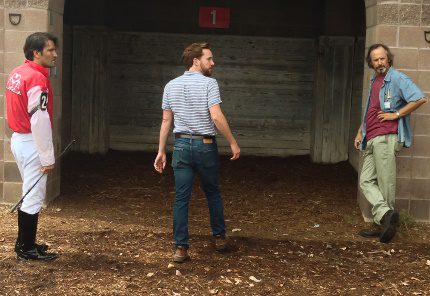
“Jockey” recently completed production, almost entirely at the Turf Paradise racetrack in Phoenix, Arizona. Bentley and Kwedar had largely chosen Turf Paradise over other U.S. tracks because of its old-school appearance and the wealth of interesting characters that inhabit the place.
Turf Paradise Racetrack – Phoenix, Arizona
The film is unique on a couple levels; they only hired three Screen Actors Guild actors and the rest of the cast is comprised of various denizens of the track, including the general manager and the head of security.
What also makes this project different is how the film is being financed. Along with utilizing traditional investors, the film’s crewmembers all agreed to work for below-market rates in exchange for being investors in the project. Typically, this is called a deferred payment, often cynically referred to as a “de-freed” payment — as very few such projects ever see any return at all. The difference this time is that the crew will see any incoming revenue at the same time the investors do, not after paying them back first.
This arrangement allowed for less money to be raised up front and made for a more collaborative on-set environment — as everyone has a personal stake in the outcome. “The beauty of it was that we could immerse ourselves in the community, the crew is allowed to make creative suggestions to improve the end product.”
As soon as production on “Jockey” had begun in earnest, one of the studios that Bentley and Kwedar had been in stalled talks with decided they wanted them to start writing a script for them. Work begets work. “This would be our first one to try within the big studio system. To try and make something with a point of view and says something, while also trying to appease a large company that is trying to appeal to the most people. It can feel like the tail is wagging the dog, but you just kind of give yourself up to it, this is what we’re doing, let’s see what happens.”
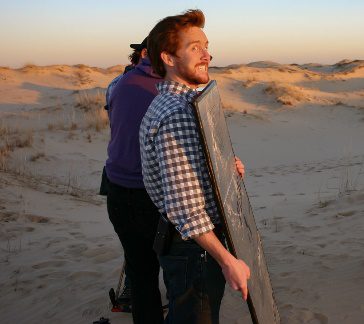
Bentley in a reflective moment – Monahans, Texas 2012
Bentley has acknowledged some previous misconceptions about the business. For one, he has sworn off attempting to predict how his colleagues’ projects would fare. “It’s funny, the movies that I thought did great didn’t do that well, then I’d find out some others I thought wouldn’t do as well are doing great.”
Bentley also used to tie financial success to personal success. “Before ‘Transpecos’, I was thinking, if it makes money that will be a success. If I make money off of it, that will be a success. I’ve not made a dime off of it (‘Transpecos’) compared to what I’ve spent to get it made out of pocket, but I feel great about it. It doesn’t change my feelings about that movie at all.”
Bentley recalls a moment where he accidentally received some commiseration from the cosmos. “Greg and I were in New York for some meetings, it was cold and late and there was an Italian restaurant that only had outside tables available — so we grabbed one. Another couple of guys did the same thing. One of them happened to be director Cary Fukunaga, who had been directing the series True Detective and had just completed the film, Beasts of No Nation. Fukunaga was saying to his friend, ‘Man, I just need to make some money, I just gotta figure out how to make some cash soon.’ Just hearing him gripe about the same things we had been griping about was very eye-opening. It was more encouraging than anything, knowing that this guy who I look up to is struggling as well.”
Bentley has this to offer up-and-comers, “If I can tell any young (independent) filmmaker anything, don’t expect this to be what you make money off of. You can make some cash in the commercial world.”
“I grew up poor. I’ve been broke at times, I’ve had money at times. Being broke doesn’t bother me. As long as my eyes are open going into it and have my expectations set, I’m fine with it.”
“Now that ‘Jockey’ is done I think I’m gonna try to pick up a couple commercials.”
“Jockey” during production
Some Big Fish in a Small Lago
By Sean McCormick
04/19/2019
In 1999, Milton Wright, a now-79-year-old retired African American man and his wife, Helen, moved to Lago Vista, Texas. At that time there were fewer than 40 black people in the entire city. Wright’s reason for moving to Lago Vista was simple: he wanted to retire out in the hills by Lake Travis. “We saw a house we liked, bought it, that’s it,” he said.
In the 1930s, a series of dams were built along the Colorado River to prevent flooding, which created the Texas Highland Lakes. Lago Vista was initially developed to be a lakeside retirement resort on Lake Travis in the 1960s. Eventually it incorporated in 1984 to prevent annexation by its much larger neighbor, Austin.
Having grown up in Waterbury, Conn., Wright is familiar with the small-town lifestyle. He is aware that there is a small minority community in Lago Vista. “I don’t know too much about it,” Wright admits. “When we go to plays, we’re generally the only minority couple there. But that’s not unusual,” he added.
According to 2017 Census data, of the 6,815 people currently residing in Lago Vista, 3% are black. This is less than a fourth of the national average of 13.4%. Texas overall, has an average that is more in line with the U.S. at 12.7%. Lago Vista placed 13th as “whitest city” in Texas, according to the rankings site RoadSnacks.
Andy Cox and his husband Darrell reside in a Lago Vista census-wrecking household: a white, same-sex, married couple with three minority foster children comprised of two black girls and one Hispanic boy. Last November, their black foster daughter, Ke’auvia, moved to Lago Vista from Temple, Texas, which is 17.3% black. She is the only black girl in her fourth-grade class at Lago Vista Intermediate School. Cox feels the transition to the new school went smoothly for her. “There have not been any racial issues, no tension. They were lined up at school to welcome her once they learned she was coming. I think it’s been more awkward for me. I’m noticing that she sticks out like a sore thumb, but she doesn’t seem to notice it.”
Wayne Woodall, a white, 70-year-old forensic engineer who moved to Lago Vista in 2014, has had a similar experience. His daughter, whom he adopted from Mexico and her daughter, Angie, who is half-Hispanic and half-black, moved from Houston to live with Woodall and his wife last year. Houston’s black population comprises 23% of the city. Like Cox, Woodall felt the transition went well but was a bit jarring at first. “It was kind of a shock for my granddaughter, coming from Houston. After her first day at school she said, ‘I’m the only black kid here.’ She’s been accepted really well and made a couple friends. She didn’t experience any bullying or anything,” he said.
After almost 20 years in Lago Vista, Wright has no regrets regarding his decision to move to the area. “I’ve never really encountered anything that would discourage me from being out here. It’s been a pretty friendly town. All our neighbors we know. It’s always been very cordial. Friendly people,” he said.
An overview of the city. Photo: Sean McCormick
The cause of the demographic disparity is difficult to pin down. Lago Vista is not reminiscent of an old “sundown town” of yesteryear, like Vidor, Texas.
Ann Murrow, a Lago Vista real estate broker and founder of the Lago Vista Women’s Club, insists that the lack of diversity in Lago Vista is not by design. “It’s a federal law that you cannot redline anybody out of a community. That happened in the 1970s. No more,” she said. Redlining is a procedure where real estate agents selectively show — or don’t show — homes in specific areas. The Fair Housing Act of 1968 was created to prevent such discriminatory real estate practices.
Wright suspects it may be a combination of things. “At one point this was designed to be a suburban community for seniors. It doesn’t really have any economic development for serious employment,” he said. Wright’s commute to work before he retired got up to 50 miles per round trip.
City Manager Joshua Ray also suspects employment is an issue. “The job market in Lago Vista is not as strong as in other communities that may have larger populations. The drive on 1431 to Cedar Park, Austin, Round Rock, Leander, Marble Falls and other regional cities is not great in distance but could be seen as a possible deterrent to some people that do not enjoy driving on a hill country road,” says Ray.
Wright feels that being different in a community can be an opportunity. “I have a theory, that we’re communicating more, we’re not as separated as we were in the old days. There was always what people thought other people did. Now you know that they aren’t much different than you. You’re not isolated. Out here, the fact that you’re the only kind of a particular ethnicity doesn’t really matter at all,” he said. “After a while the differences melt away.”
Lago Vista High School chooses to coexist with smartphones despite hurdles
A warning outside a Lago Vista High School Classroom
By Sean McCormick
Jim Ed Baugh, who teaches the Lago Vista High School audiovisual program, recently noticed one of his students taking a picture of his math homework with an app on his smartphone. The app then solved the math problem, based on the image.
At Lago Vista High School, despite the no-cell phone flyers posted outside the classrooms, teachers are allowed to make the call whether to incorporate smartphones into their curriculums, which has created some challenges.
Lago Vista’s first school was a single-teacher, one-room affair, established in 1895. If there was a student handbook back then, it was probably nothing like the 144-page document that currently exists. According to the 2018-19 Lago Vista ISD Student Handbook, “In some cases, students may find it beneficial or might be encouraged to use personal telecommunications or other personal electronic devices for instructional purposes while on campus.” Students must obtain prior approval and sign a user agreement in order to bring a smartphone to school.
Some students struggle with self-control during class. Communications teacher Steve Garcia once caught a student watching the television show Grey’s Anatomy during his lecture. If a student appears to be having difficulty paying attention, the device is taken from them. If it ends up in the office, it costs $15 to get it back.
It’s not just television shows that are diverting attention. Social media can also be a distraction for young people throughout the day. According to computer science teacher Rebecca Holt, Snapchat and Instagram are the two most popular social media applications at the high school. Holt recalls asking some of the girls in her class, “How many pictures can you take of yourselves?”
Smartphone use has also made it into the 504 plans which accommodate students with special needs. Garcia has one student who is allowed to play video games on his smartphone as part of his 504 plan. This required Garcia to explain the situation to the rest of the students, so they aren’t resentful or confused. “We talk a lot about the fact that equal is not always just,” he said.
Regarding whether smartphones in the classroom are affecting student performance, Baugh is unsure. “It’s hard to tell if devices are having an effect on test scores because it’s too difficult to establish a control group,” he said. According to technology teacher Heather Womack, student’s personal device ownership is over 90%. In 2018, Professor Arnold Glass and graduate student Mengxue Kang conducted a study with students at Rutgers University that utilized control groups. They concluded that test scoring and the ability to recall information was higher without devices present.
Figure 1: Arnold L. Glass & Mengxue Kang (2018): Dividing attention in the classroom
History teacher Scottie Johnson feels students need to learn self-control while they are still in grade school. “Before the web, there were kids who weren’t paying attention: they were writing notes, they were doodling, they were staring at a wall. I don’t think devices turn good students into bad students. The kid who is off-task is going to be off-task, no matter what. I liken it to, as an adult, you have to learn how to sit next to cake. If everything’s locked down in high school, when they get to college it’s novel and potentially costly,” she said. Glass disagrees. “It is obvious to anyone who has stood in front of a class that watching a video on a cell phone is qualitatively different than doodling or staring at a wall because it is much more interesting and absorbs much more of the student’s attention,” he said.
The school district has been pressured by parents to allow phones into the classroom. There are working and single parents who want to be able to relay scheduling issues, even though the students have access to email via their school-assigned iPads. According to Garcia, Womack, Baugh and Holt, some parents are abusing this communication convenience. Parents will call and text during classes about non-essential issues, putting the students in a bind, and they then request permission to either answer a text or take a call in the hallway. According to recent Lago Vista High graduate Zoe Schneider, “A lot of parents think they’re above the school system. My parents would text me during the day, but I would only respond between classes.”
These issues aside, most faculty at the high school feel a ban on smartphones would be impractical. Baugh doesn’t feel eliminating the devices is the answer. “Just like prohibition with alcohol, kids are going to find a way around it. It’s just denying the inevitable. Before, teachers would be like, ‘You’re never going to have a calculator on you all the time.’ Well, now you do. Better to get out in front of it and try to control it, use it purposefully. Let them (the students) use it as a source of information,” he said.
The State of Texas Assessments of Academic Readiness or STAAR Test now allows students to listen to music without lyrics using earbuds or headphones as a focusing device while test-taking.
Lago Vista High School Principal Heather Stoner is optimistic. “I don’t see the difference today being as much about the technology as it is about collaboration. Coming to consensus, working together and communicating. All those soft skills are just as important as the academics. I think today’s kids are awesome. I think about who I taught 20 years ago, these kids are just better problem-solvers and thinkers — just great to be around. The kids now are interactive,” she said.