After 32 seasons, Cops — a reality television show once described as a “one-celled amoeba” by co-creator Stephen Chao — has been cancelled by Paramount.
On June 9, a Paramount Network spokesperson made a no-frills statement regarding the cancellation to the New York Times. “Cops’ is not on the Paramount Network and we don’t have any current or future plans for it to return,” they said.
Even though Paramount officials did not elaborate on their reasoning for the cancellation, the recent resurgence of the Black Lives Matter movement and the global protests over George Floyd’s death make a partnership with a show like Cops morally repugnant and potentially bad for Paramount Network’s evolving brand. As evidence, on June 1, Paramount and other Viacom channels went dark for eight minutes and 46 seconds to commemorate the amount of time that former Minneapolis police officer Derek Chauvin had his knee on Floyd’s neck.
This is not the first time that Cops has been cancelled. In 2013, the Fox network dropped the show upon the conclusion of its 25th season. Racial justice advocate group Color of Change had been pressuring the network to cancel the show and created a petition that received over 35,000 signatures. “With its history of dehumanizing and racially inflammatory portrayals of people of color, Cops paints a damaging and distorted portrait of crime and the criminal justice system,” Color of Change claimed in an excerpt from their petition.
Cops was immediately acquired by Viacom cable channel Spike TV in 2013 for its 26th season. Maybe Spike TV would work with Cops’ production company, Langley Productions, to update the show’s format to be more commensurate with the public’s increasing calls for racial justice and police oversight?
Nope.
It was business as usual. Then-president of Spike TV, Kevin Kay, in an interview with TV Guide, made it clear that Spike TV had no plans to meddle with the show. “We told them (Langley Productions), ‘You guys know this better than we do.’ It’s perfect, we have a tremendous amount of trust,” Kay said. Kay later stepped down as president of the Paramount Network (formerly Spike TV) during Viacom’s consolidation in October 2018.
This tone-deaf level of hands-off management from Spike TV invited Cops’ seven-year slide into irrelevancy. Had there been any introspection and objective thinking then, the show might have implemented some critical adjustments that could have countered the public’s increasingly negative perception of police behavior. Instead, they doubled down on their original, lurid formula of heavily edited, seven-minute segments — where the good guys always get the backstory-less bad boys off the street.
They might have gotten away with it, too, if it hadn’t been for those meddling kids and their cell phones.
Cell phones with built-in video cameras.
Since Cops switched networks in 2013, social media has been inundated with material from amateur videographers. The rise of public platforms like YouTube ushered in an era where content trumps production values. Just about any stunt or mishap can be viewed on demand these days — including the actions of abusive police officers.
All of a sudden, police shows like Cops, and its younger, hotter cousin, Live PD, began losing control of their sacred narrative — that police officers are perennially competent professionals, capably dealing with the worst society has to offer. With the entire planet now able to witness a seemingly endless series of unedited negligent and violent police incidents, a show like Cops seems anachronistic and disingenuous.
Cops raison d’être was to broadcast a 22-minute pro-law enforcement commercial and recruitment tool every Saturday evening. Public relations-improving propaganda is what Langley Productions provided to troubled police agencies for access to their officers and hardware in lieu of any financial compensation. As Cops allowed each department to approve everything that was to go on the air, these agencies had little to lose by allowing the show to film in their cities. With this editorial control, each police department could dictate their own version of reality.
Until now.
Over three decades, Cops provided a weekly justification for Nixon and Reagan’s “war on drugs” and perpetuated rock-bottom expectations of minority groups — often showcasing and making light of people who are struggling with addiction and neglect.
In a way, Cops continued the work of the Jim Crow laws that allowed even the poorest whites to feel superior to people of color.
Langley Production’s “one-celled amoeba” did not evolve and adapt to the prevailing environmental conditions, and now it’s extinct.
A Unique Problem and a Unique Opportunity
On June 8, the Los Angeles Times published an opinion piece by screenwriter John Ridley titled “Hey, HBO, ‘Gone With the Wind’ romanticizes the horrors of slavery. Take it off your platform for now.”
The next evening, HBO Max did just that.
Whether this was a coincidence, a coordinated effort or a capitulation is irrelevant. What matters is that this is a bona fide example of anti-racism on WarnerMedia’s part. A statement on the company’s website includes a possible explanation for the decision. “Like many companies, we donate to partner organizations and programs engaged in social justice work. We write checks and yet racial injustice persists. This moment teaches us that money is only a part of the solution.”
According to Ridley — who wrote the screenplay for “12 Years a Slave” — “Gone With the Wind” is its own unique problem. “It is a film that, when it is not ignoring the horrors of slavery, pauses only to perpetuate some of the most painful stereotypes of people of color,” he wrote in his op-ed.
Based on the public’s reaction, you would think HBO Max had staged a book burning. People quoting Orwell and making accusations of “virtue signaling” is a sure sign that much of the outrage is coming from those who only skim headlines and make knee-jerk assumptions. What WarnerMedia is doing is not censorship — unlike Disney’s controversial decision in 1969 to edit the “Sunflower” character out of the “Pastoral Symphony” scene in “Fantasia.”
WarnerMedia has made it clear that they are not meddling with the film’s content. “… so when we return the film to HBO Max, it will return with a discussion of its historical context and a denouncement of those very depictions, but will be presented as it was originally created, because to do otherwise would be the same as claiming these prejudices never existed,” said an HBO Max spokesperson in an interview with The Verge.
Dana Harris-Bridson, Editor in Chief of film industry news website IndieWire agrees with WarnerMedia’s decision. “In terms of taking it down and giving context to it, I think it’s entirely appropriate. To me it’s no different than NASCAR saying we’re not going to allow the Confederate flag. When you start taking sides like that, those who don’t take sides are going to stand out in sharp relief,” she said.
No ones’ First Amendment rights are being trampled here. It is perfectly within WarnerMedia’s purview to temporarily (or permanently) withdraw that title from the HBO Max platform. They didn’t remove it from Earth. In fact, Gone With the Wind became an Amazon best seller the day after it was removed, possibly due to the Streisand Effect — a societal reaction to the perception of having something taken away from it. As of this writing, there are 3,658 copies of the film for sale on eBay. It’s available.
Adding contextual content to a film of Gone With the Wind’s stature is an original move that will likely generate conversation about racial inequalities in America’s past and present. Meanwhile, the highly controversial Civil War epic “The Birth of a Nation” is currently viewable on a number of platforms with no disclaimer at all, despite its depiction of the Ku Klux Klan as heroic and African-Americans (some being white actors in blackface) as sexually aggressive, subservient predators.
Does this stop with Gone With the Wind? Given a long enough timeline, just about any film could possess some culturally objectionable component, and many do for a number of reasons. The war propaganda in The Green Berets, the glorification of date rape in Revenge of the Nerds, the negative depiction of Native Americans in westerns.
Is there enough time, money and willpower to address every culpable project in the Internet Movie Database’s 6.5 million titles? Of course not, but there should be some case-by-case efforts made to provide context to some of the larger offenders. Ridley has acknowledged that there is a difference.
“I would ask that all content providers look at their libraries and make a good-faith effort to separate programming that might be lacking in its representation from that which is blatant in its demonization,” Ridley writes.
Harris-Bridson believes Gone With the Wind was such a special case. “It’s the most popular movie in history in terms of box office. It has as big of a target on its back as anything. I wouldn’t be surprised if someone isn’t going through the catalog (WarnerMedia’s) right now to flag other potential candidates and figure out what will need addressing,” she said.
One of the only upsides to the COVID-19 pandemic is that it has hit the world’s pause button and allowed us to reevaluate some status quos. The societal station wagon is not going 70 mph, making this moment a good time to tinker under the hood and change a tire or two. Providing contextualization to a classic like Gone With the Wind is just one example. Difficult subjects like racial inequalities in both society and business, police reform, education, climate change — are all on the table now.
The Simpsons and I have had a near-daily relationship for decades now — it was the only therapy I could afford during my turbulent 20s. The show is both a celebration and an occasionally savage indictment of the times we live in. I owe it my fealty.
Sadly, my beloved show — now heading into its 32nd season — might be missing a familiar face this Fall.
In January 2020, voice actor Hank Azaria announced that he was voluntarily stepping away from the role of Apu after receiving criticism that the Apu character was an Indian-American stereotype being played by a white actor. “Once I realized that that was the way this character was thought of, I just didn’t want to participate in it anymore,” Azaria told the New York Times in an interview.
Indian-American comedian Harry Kondabolu felt so strongly about the Apu character that he made a documentary in 2018 called “The Problem With Apu,” which advocated for the character’s removal from the show.
Apu first appeared on The Simpsons in “The Telltale Head”, which aired in February 1990. Back then, it was hardly a stretch that a convenience store might be run by someone of Indian or Pakistani descent. The overwhelmingly poor response to Kondabolu’s documentary trailer suggested that he might be an outlier. Was Kondabolu’s crusade “wokeness” gone amok or was there substance to this?
One of the main complaints was Azaria’s broadly comical version of an Indian-American accent. In the documentary, actress Sakina Jaffrey described it as “patanking” — to speak English with an exaggerated enunciation that is more an offensive caricaturization than an accurate representation of an Indian accent. Many Indian-American actors have felt cursed with this expectation when trying to find roles to play.
Not everyone wanted him gone, however. Opinion columnist Bhaskar Sunkara was in support of keeping Apu on the show. “Apu was an emotionally developed character, much more so than other Simpsons characters, he cared about his family and worked tirelessly to support them. He was also allowed to be zany and kooky – he wasn’t just there in the background, he had his own plotlines, he was neurotic, unique, not just a prop for diversity,” he wrote in a 2018 column for The Guardian.
Kondabolu’s documentary did inspire me to dig deeper into my own interpretation of his issue with the Apu character. It finally struck me that his generation of Indian-Americans are around the same age as The Simpsons. They are much more mainstream now and many are desperate to separate their hard-won identities from the worn-out Indian-American tropes that they feel Apu Nahasapeemapetilon perpetuates. Tropes that are pretty easy for white viewers to become too comfortable with.
I also realized that The Simpsons have failed to evolve commensurately with the times during its three-decade run. That’s an eternity in American culture. They had over 600 episodes to implement a Darwinian gradualism to the different characters to prevent any of them from becoming anachronisms. By the time the show finally acknowledged there might be a problem, it was too late. Their response to Kondabolu’s claims came across as strangely tone-deaf.
Apu was demonstrably a funny and thoughtful character at times, but his foibles as a stereotype were never at my expense as a white male.
The Simpsons have had a great run, but the show’s been in hospice for a while and there are rumors afloat that it might be taken off of life support after this upcoming 32nd season — with or without Apu.
Are We In?
By Sean McCormick
At the beginning of the workday on any film set, the first thing heard is, “we’re in, we’re in!” It’s the production world’s equivalent of a factory whistle. Thousands of furloughed television commercial workers — including yours truly — yearn to hear this again. It’s time we got back to work.
Commercials tend to pay more than other types of projects. There’s a reason for this. If they didn’t, no one would agree to work on them. The days are fast-paced and can run anywhere from 10-18 hours long. They often include multiple locations, cramped and uncomfortable conditions, temperamental directors, nitpicky clients and a daily to-do list that is often the stuff of fantasy.
Not anymore.
For commercial production to be successful in the age of COVID-19, ad campaigns will need to be designed from scratch to reflect the limitations brought about by film crews and actors who are having to potentially work alongside the coronavirus.
“The creative needs to match the reality of what we can do. It’s going to need to be one location with half the crew size we’re accustomed to. I have one client that I work with every year. I told him that whatever y’all come up with needs to be one or two actors in one location, with no extras,” says Christopher Rogers, an Austin-based production supervisor.
I won’t miss the extras, but they want us to halve the crew size, now? The last commercial I worked on had over 40 people working and we barely managed to get everything done by sundown. Sweden’s COVID-19 filming guidelines estimate that the new workflows and smaller crew sizes “will cause a small decrease in productivity. We estimate this at about 10%.”
This is a hilarious prediction with which production company owner Ashley Bergeron-Ford disagrees. “I’m thinking more of a 30 to 40% increase. 12-hour shoot days — ain’t happening anymore. Not until we have a vaccine,” she says. Rogers concurs with this. “It’s going to take more time to get things done; we’re going to have to manage our clients expectations,” he said.
This is good news for beleaguered crew members, but I suspect these new constraints will introduce a few problems.
Time is the most valuable commodity on any film set. Adding a day or two to a project’s schedule, along with the new medical personnel and additional production assistants, is going to be expensive.
Rogers isn’t terribly troubled by this. “You are no longer going to have 15 agency and client personnel flying in. That can cost 20 or 30 grand on a shoot. You’re no longer going to have gift bags. I think you’re just moving your money around,” he says.
Virtualization of the clients will be nice but accommodating the on-set director while navigating 10-20 different Zoom participants’ “thoughts” is possibly going to bog things down. “I have an entire page written about patience,” says producer David Wolfson. “They are going to have to understand that it’s just not normal anymore.”
Rogers believes that enhanced pre-production planning will be essential for success. “They’re going to have to make up their minds on all sorts of things beforehand: props, wardrobe, set dressing — they can’t decide on the day,” says Rogers. Personally, I’m a little skeptical of this claim. I recall working on a spot for the Container Store last year where it took over two hours to roll the first take due to 15 people disagreeing about how many shoes to place in a closet.
Assorted growing pains with the workflow aside, when the Governor’s Strike Force to Open Texas finally allows us back in, this new normal looks to be way better for us workers. At least, until there’s a vaccine.
Turn off the Webcams and Cellphones – a Plea to Celebrities
By Sean McCormick
As an entertainment industry technician and a big fan of music, theatre and film, I’m making a plea to celebrities: please turn off your webcams and cellphones.
It’s understandable that furloughed celebrities are getting bored and stir-crazy—it has to be jarring for those who were involved with dynamic projects to suddenly be relegated to a form of house arrest.
However, some performers’ innate need to share their gifts have led to dubious decisions over the last few weeks. Many self-quarantined notables have released well-intentioned yet occasionally ham-fisted, self-produced offerings to various social media platforms. This potentially dilutes their brands and may negate the valuable escapism that their carefully-cultivated career personas provide.
Perhaps there are some fans who are enjoying witnessing their idols as zoo animals that pontificate in their bathrobes over the rigors of being stranded in their mansions, like the video that singer Sam Smith caught flak for last month. But, the novelty wears thin quickly.
Celebrity-infused, tone-deaf, Kumbaya efforts like Gal Gadot’s collection of 25 celebrities doing an acapella version of John Lennon’s classic, “Imagine”, aren’t helping, either. The irony of wealthy people butchering a beautiful song about a possession-free fantasy world as a “gift” to people who may soon be without a roof, apparently didn’t occur to anyone involved.
One YouTube commenter (Valori Joy) summed it up well: “This isn’t moving. They’re singing a song about not having possessions and crap from their mansions surrounded by luxuries. Get tf outta here.”
One possible economic downside for these home-rolled performances is the potential for lowering expectations for the production value of these efforts.
The entertainment industry employs an army of various technicians and professionals who contribute to the artists’ fabulous end products. These technicians (like myself) are probably sitting at home now on unemployment—if they are lucky—most likely not taking any comfort from these ramshackle appearances. Hearing Seth Meyers sound like he’s broadcasting from a shoebox while my van full of expensive audio equipment is gathering dust outside is vexing.
YouTube, reality television and other platforms have dumbed down audience expectations of quality for years now, but there is still a demand for well-produced escapism. I’ll take Brad Pitt fleeing space pirates on the Moon over some reprobate housewives throwing cheap Chardonnay at each other, any day. While it’s probable that this all shall pass when the studios, venues and theaters eventually reopen—entertainment workers’ anxieties about their livelihoods are valid.
Some celebrities are getting it right, however. Recently, the Prince estate released Prince & The Revolution: Live on Prince’s YouTube channel to support the COVID-19 Solidarity Response Fund. Peter Hook (of New Order) and the Light also recently released a past show to benefit the Epilepsy Society. A little more than a month ago, Andrew Lloyd Weber shared several musicals on YouTube. The smash musical “Hamilton” is being released a year early. More of this please!
Celebrities, instead of jumping around in your backyard in a cell phone video that’s giving everyone vertigo, why not lobby your bosses to release some of your old gems! Such charitable acts could help others, provide a temporary lean-to shelter from reality and reinforce the grandeur of well-produced material. You’ll be back in the limelight soon enough.
The carefully-crafted mythos of our icons are what sold us on these performers in the first place—the process that creates them employs thousands. Instead of providing a much-needed diversion from this quagmire, this homespun “quarantainment” simply reminds us of the plight we are in.
Celebrities, take five, please.
EYES WIDE OPEN
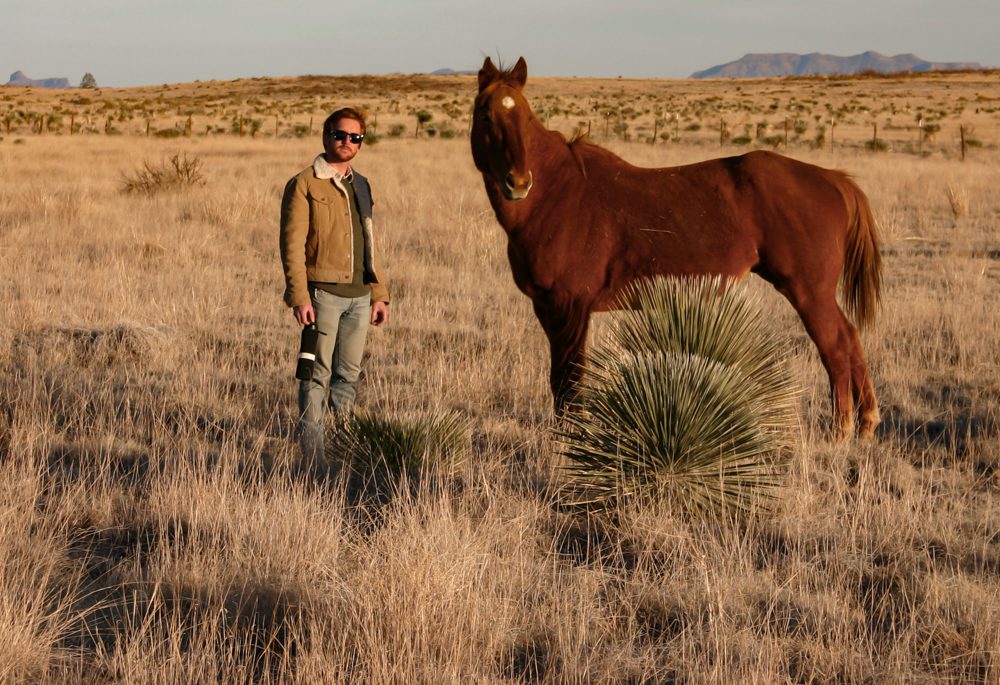
Texas filmmaker Clint Bentley
“Everyone may know of your idea; even though, it will never be as it real as you thought.” ― Alan Maiccon
Independent filmmaking is often a dubious and quixotic endeavor, better-suited for chess players than first-person shooters. Truly, a get-poor-quick scheme that only promises seemingly endless pitfalls and compromises. Producing a finished piece requires a manic tenacity and a visceral connection to the concept of delayed gratification. It involves the planting of many seeds with the knowledge that it may take months or years to see anything come to fruition.
Clint Bentley, a 34-year-old Dallas-based filmmaker, understands this.
Having grown up on a working cattle ranch near Daytona Beach, Florida, Bentley was often alone with his thoughts and his chores. Performing difficult work that might not show results for extended periods of time. This arduous environment developed a work ethic and mindset that has become a valuable asset to his current career.
The Bentley family back then didn’t have cable, so rented movies were the main form of entertainment in their doublewide. There were no friends nearby, so free time was often spent alone in wooded areas that were peppered with old and weathered abandoned structures. Plenty of fodder for a young person’s imagination.
An English major in college, Bentley took a hiatus from his studies to try his hand as a singer-songwriter, living in friend’s stairwell in New York. It proved to be a short-lived digression — Bentley quickly realized that particular brass ring was safely out of his reach. His time in NYC wasn’t entirely a bust — while there, he was exposed to foreign films that inspired him and expanded his worldview.
Bentley returned to Stetson University with this new appreciation for film to finish his Literature degree. He wanted to make a documentary about the U.S. – Mexico border and applied for and received a SURE grant from the school to finance it. As the grant was $2500, it basically paid for a modest camera, some travel expenses and little else. It was titled, “Boulders Fall to Each.”
After college, Bentley took a stab at making some short films, one was titled “I’ll Remember Everything”, which he describes as a “pretentious film with a pretentious title.” But these early forays provided some personal and professional calibration. “What kind of stuff gets you off, and what kind of stuff do you not care about? There’s only one way to find that out, and that’s by doing it. Everybody’s a perfect filmmaker when they are sitting around dissecting other people’s movies,” said Bentley.
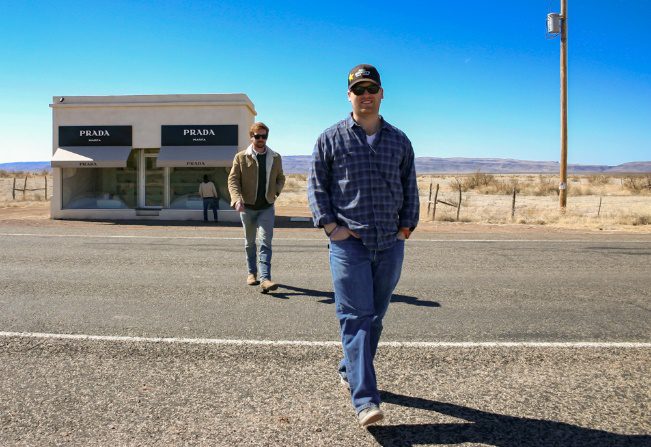
Bentley and Kwedar
In 2010, Bentley’s parents decided to move to Texas. Bentley himself was toying with relocating to Austin or Paris when he met his now-wife Rachel. She introduced him to a guy named Greg Kwedar that she went to college with at Texas A&M. Kwedar was a filmmaker who had been doing some things at the border as well.
Bentley and Kwedar hit it off and began collaborating on a feature-length film about the Border Patrol called “Transpecos”. It would only take them six years to get it made.
The script for “Transpecos” went through several phases over the years, with the final shooting version being a good deal more conservative in scope versus one of the earlier drafts, due to time and financial constraints.
While fundraising for “Transpecos”, Bentley and Kwedar decided to make a short film called “Dakota” — a similarly-themed proof of concept. Making “Dakota” allowed them to get a better feel for the logistical hurdles to come and provided a test drive for their new roles: Kwedar as director and Bentley as producer.
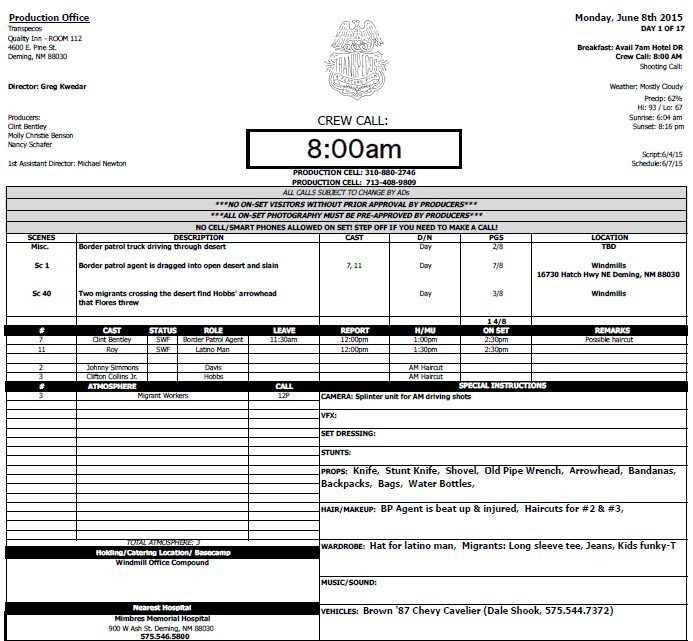
“Transpecos” Call Sheet Day 1 of 17
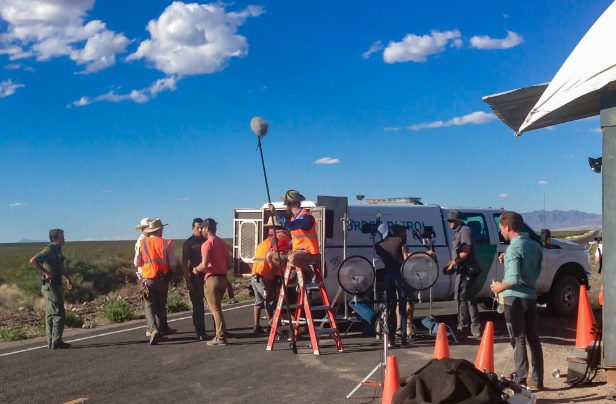
Production on “Transpecos” finally began on June 8, 2015. A mere 17 days were allocated to shoot the entire film, most of which was set in a sweltering desert area outside of Deming, New Mexico. The average temperature was 112 degrees. Some crew member’s shoes were melting on the pavement during production.
“Transpecos” wound up being a hit on the 2016 festival circuit, including the prestigious South by Southwest Film Festival, where it won the audience award for best narrative feature. It was then picked up for distribution by Samuel Goldwyn Films. Bentley and Kwedar were chosen among the 25 screenwriters to watch in 2017 by MovieMaker Magazine. Bentley was all set.
Then his alarm clock went off.
“Transpecos” during production
“I thought it would be more successful than it was. I thought it would be easier. It took about four years to raise the money. After it was done and had turned out decent, I thought, alright, all our dreams are going to come true. I told my wife that when we sold it (‘Transpecos’), I was going to buy a motorcycle. I didn’t realize selling the movie doesn’t make you any money. I got back from shooting ‘Transpecos’ and was having to take little odd production jobs.”
“‘Transpecos’ did well for itself, made more than was spent on it. However, the distributors skim so much off the top of each online play. This starts even before the investors are repaid. There was a lump sum that was initially paid out, but it’s not a very big lump. The rest of the film’s income is directly tied to sales.”
Bentley and Kwedar have now been working together for almost a decade, they are currently juggling 6-7 projects in different stages of development. While they don’t have a written down, exclusive agreement (Bentley does some freelance writing on the side and Kwedar has helped produce a couple of documentaries), the vast majority of their efforts are collaborative.
“The best part of having a partner is that you have someone to celebrate with when things are good, and someone to commiserate with when no one is calling, and things are shitty. I realized how rare that is in the filmmaking world to have somebody else in the trenches with you all the time. It’s also hard to find someone who will be honest with you about your work, and you as a person.”
Years can go by while each endeavor is finding a home. Two of their projects are both over three years old at this point. There can be some epic, faith-testing lulls to navigate. “These days, I always try to keep working, even if nothing is happening or coming through.”
One such lull drove Bentley and Kwedar to put one of their older projects on the front burner. A narrative feature film about an aging horse jockey who is facing his last season. “We just figured out what the bare minimum amount we’d need to raise to get it made and drummed up the funding.”
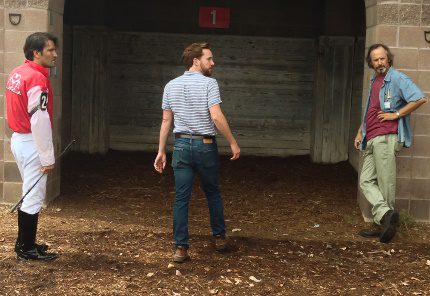
Bentley directing a scene from “9 Races”
They had already produced a jockey-themed short film in 2016 called “9 Races”, which, like “Dakota”, was a test run at the feature film’s subject matter. This time Bentley would direct and Kwedar would wear the producer hat.
“Jockey” examines the different aspects of professional horse racing — a routinely dangerous lifestyle where accidents are common, and jockeys often continue to work while injured. One of the initial inspirations for “Jockey” (the film’s current working title) was Bentley’s father, Robert Glenn Bentley — a horse trainer and rancher who had been a jockey himself for decades.
Years after having retired from racing horses, Bentley’s father was diagnosed with injury-related ALS and passed away on New Year’s Eve in 2014.
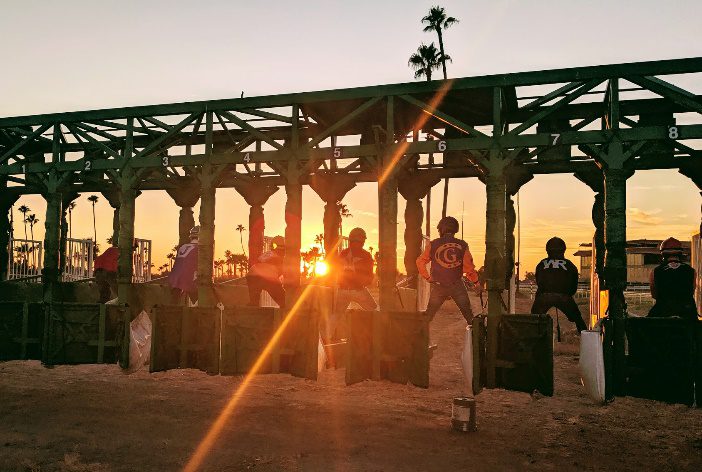
“Jockey” recently completed production, almost entirely at the Turf Paradise racetrack in Phoenix, Arizona. Bentley and Kwedar had largely chosen Turf Paradise over other U.S. tracks because of its old-school appearance and the wealth of interesting characters that inhabit the place.
Turf Paradise Racetrack – Phoenix, Arizona
The film is unique on a couple levels; they only hired three Screen Actors Guild actors and the rest of the cast is comprised of various denizens of the track, including the general manager and the head of security.
What also makes this project different is how the film is being financed. Along with utilizing traditional investors, the film’s crewmembers all agreed to work for below-market rates in exchange for being investors in the project. Typically, this is called a deferred payment, often cynically referred to as a “de-freed” payment — as very few such projects ever see any return at all. The difference this time is that the crew will see any incoming revenue at the same time the investors do, not after paying them back first.
This arrangement allowed for less money to be raised up front and made for a more collaborative on-set environment — as everyone has a personal stake in the outcome. “The beauty of it was that we could immerse ourselves in the community, the crew is allowed to make creative suggestions to improve the end product.”
As soon as production on “Jockey” had begun in earnest, one of the studios that Bentley and Kwedar had been in stalled talks with decided they wanted them to start writing a script for them. Work begets work. “This would be our first one to try within the big studio system. To try and make something with a point of view and says something, while also trying to appease a large company that is trying to appeal to the most people. It can feel like the tail is wagging the dog, but you just kind of give yourself up to it, this is what we’re doing, let’s see what happens.”
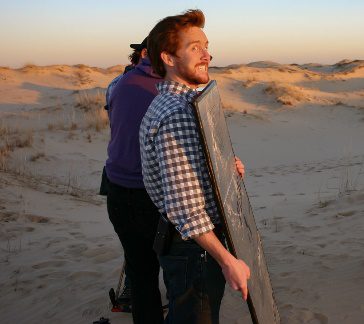
Bentley in a reflective moment – Monahans, Texas 2012
Bentley has acknowledged some previous misconceptions about the business. For one, he has sworn off attempting to predict how his colleagues’ projects would fare. “It’s funny, the movies that I thought did great didn’t do that well, then I’d find out some others I thought wouldn’t do as well are doing great.”
Bentley also used to tie financial success to personal success. “Before ‘Transpecos’, I was thinking, if it makes money that will be a success. If I make money off of it, that will be a success. I’ve not made a dime off of it (‘Transpecos’) compared to what I’ve spent to get it made out of pocket, but I feel great about it. It doesn’t change my feelings about that movie at all.”
Bentley recalls a moment where he accidentally received some commiseration from the cosmos. “Greg and I were in New York for some meetings, it was cold and late and there was an Italian restaurant that only had outside tables available — so we grabbed one. Another couple of guys did the same thing. One of them happened to be director Cary Fukunaga, who had been directing the series True Detective and had just completed the film, Beasts of No Nation. Fukunaga was saying to his friend, ‘Man, I just need to make some money, I just gotta figure out how to make some cash soon.’ Just hearing him gripe about the same things we had been griping about was very eye-opening. It was more encouraging than anything, knowing that this guy who I look up to is struggling as well.”
Bentley has this to offer up-and-comers, “If I can tell any young (independent) filmmaker anything, don’t expect this to be what you make money off of. You can make some cash in the commercial world.”
“I grew up poor. I’ve been broke at times, I’ve had money at times. Being broke doesn’t bother me. As long as my eyes are open going into it and have my expectations set, I’m fine with it.”
“Now that ‘Jockey’ is done I think I’m gonna try to pick up a couple commercials.”
“Jockey” during production
From Hater to Player
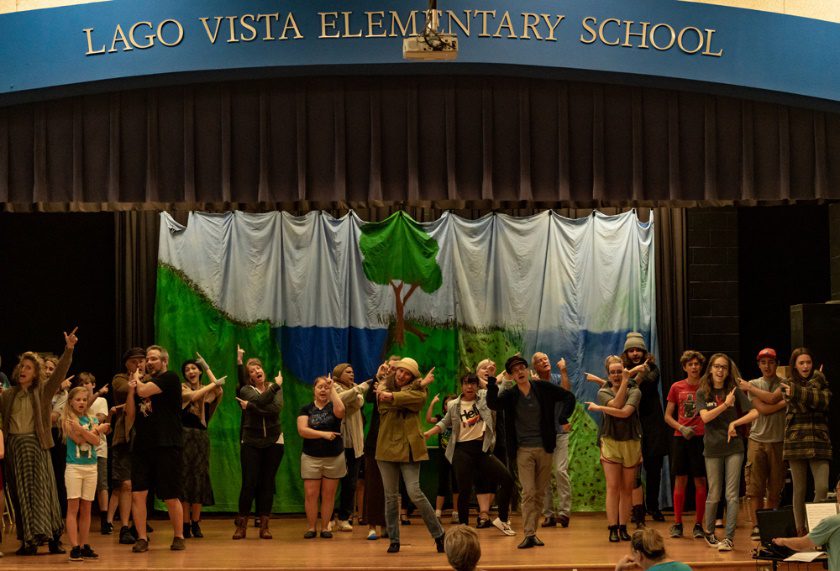
Cast of Annie rehearsing at an elementary school
By Sean McCormick
Come on, kids, we got some rehearsing to do. —Babes in Arms
Over the years, “community theater,” a term coined by author and director Louise Burleigh in 1917, has often been depicted in an awkward light: uncomfortable venues with poorly-functioning or no sound systems, anemic or thunderous air-conditioning, ramshackle set pieces and flats, overused costumes and aging, over-emoting actors struggling to recall their lines. The humorous online newspaper The Onion has published a few satirical gems: “Homeless Man Describes Horrors Of Sleeping In Public Park During Community Theater Production Of ‘The Tempest’”, “Wrinkly, Oversized Trench Coat Returns To Stage For 34th Season With Local Community Theatre” and more recently, “Judge Sentences Lori Loughlin To 100 Hours Of Community Theater.”
Filmmaker Christopher Guest, best known for his role of Nigel Tufnel in the iconic rockumentary “This is Spinal Tap”, made a feature film called “Waiting for Guffman” in 1996 about a fictional community theater in Blaine, Missouri. The title is a nod to the Samuel Beckett play, “Waiting for Godot”, which has been a longtime staple of community theater. Guest found the inspiration from watching his daughters perform in a production of “Annie, Get Your Gun.” “I was just drawn to the idea of how earnest everyone was, how devoted they were to do the best performance they could, albeit at the level that they were working at. There’s something charming about the expenditure of energy to watch these amateurs,” Guest explains in the film’s DVD commentary.
These observations have been going on for decades. Michael Green, a journalist from the U.K, where community theater or theatre is often referred to as “amateur theatre”, and sometimes in the pejorative as simply, “am-dram,” wrote a very funny book entitled “The Art of Coarse Acting” in 1964. It lovingly pokes fun at the idiosyncrasies of community theater and the public perception of the “amateur actor.”
I have to confess, for most of my life I’ve been in the camp that is quick to point out the foibles of community-produced productions. This is flat-out heresy, considering my upbringing. My parents met at an audition for a 1963 production of “Oklahoma!” at the Peninsula Playhouse in New Braunfels, Texas. My father was the audition accompanist. My mother wasn’t cast but they did the musical Bells are Ringing the following year, also at the Peninsula. They were married in 1965.
During the 1970s-80s my parents were very active in the Fort Worth theater community (which is surprisingly large — Texas has over 400 non-profit theaters, Fort Worth has at least 20). They were often involved with Casa Manana, Stage West, Circle Theatre and Scott Theatre. They jointly received a lifetime achievement award from the Live Theatre League of Fort Worth in 1999.
In the Fall of 1985, I was in my second semester at the junior college where my parents were faculty members, plodding through general education and fine arts classes in a desultory fashion (my plan was to be the drummer of KISS or something, so school was a distraction back then). I had signed up for a course my mother taught called Musical Theater Workshop. I had been taking this class since I was six or so, only this time I was eligible to receive college credit for it. The class project that semester was to collectively audition, rehearse, produce and perform the Stephen Schwartz musical “Working.” Thankfully, I landed an “A” in the class. Had I not, it would have been like the line in Cheech and Chong’s song, “Mexican Americans”: “Mexican Americans, love education so they go to night school and they take Spanish and get a B.” 38 years would pass before I would don a costume and tread below a theater’s arch again.
One of my parent’s passions was to see shows on and off-Broadway and they routinely made an eastbound hajj to the Big Apple to get their fix. My brother and I got to tag along a few times and that’s where I believe my performing arts snobbery began. Getting to experience theater done at its highest level is like witnessing a Tom Brady touchdown pass or hearing Prince riffing a guitar solo in person. The bar can be none higher. It’s a freight elevator drop to go from that to spectating at a Y.M.C.A. flag football game or having to listen to a burned-out cover band at a cash-bar wedding reception. Enduring a high school offering of Our Town is a far cry from viewing Les Misérables at the Palace in London (which I fortunately got to do in 1988).
The bustling metropolis that is Lago Vista
In 2004, when my parents found out they were finally going to be grandparents, they retired from academia and searched for a place to hang their hat that would be close to my then-wife and me in Austin. They settled on a little lakeside town outside of Austin called Lago Vista. It was originally designed as a retirement community in the 1980s, but has now become a combination of families, retirees, and vacation homes. It also has a surprisingly active arts community, including The Hill Country Singers, the Twilight Concert Series, the Lake Travis Music Theatre, and the Lago Vista Players.
The Lago Vista Players was created in 1989 by Jean Clause and was the first community theater company in the area. Once my folks had moved into town, it didn’t take them long to negate their retirement. Since moving in, they’ve now directed, played music or acted in over 20 shows, most of which involved the Players. They have also helped with the bureaucracy that is part of keeping a theater company afloat.
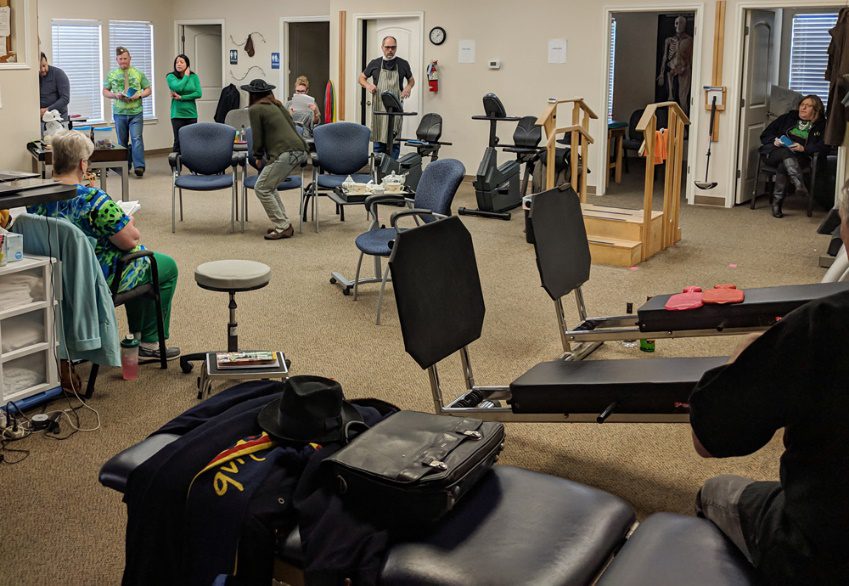
Lago Vista Players rehearsing in a therapy center
According to my mother, starting a non-profit theater group is pretty straightforward, “It’s similar to starting a church, you just need a place to conduct business and some devoted followers.” After that it gets more complicated. A board of directors needs to exist, typically filled by members of the community that have some basic business sense. There needs to be a place to rehearse and a venue to do a show in. The first production in Lago Vista that my parents were both a part of was called, “The Musical Comedy Murders of 1940.” Back then, they had to rehearse in a vacant airplane hangar at the tiny local airport with a trashcan fire going. These days the Lago Vista Players rehearse after-hours in a physical therapy center that’s owned by a friend of the group.
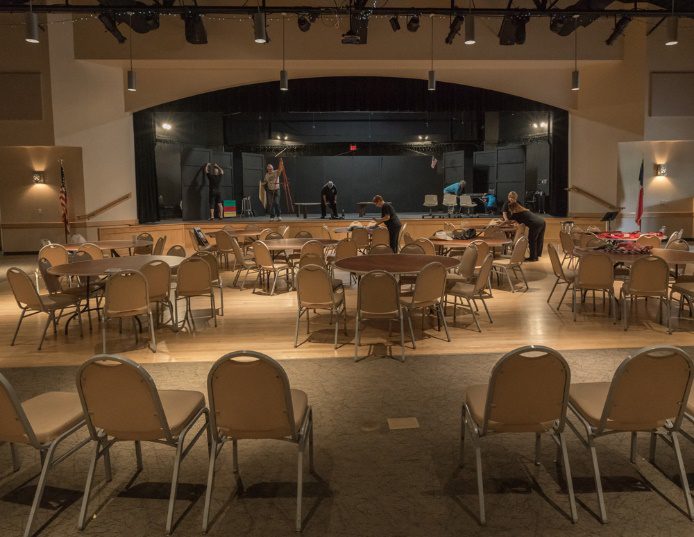
K-Oaks Clubhouse in Lago Vista
The K-Oaks Clubhouse on bucolic Bar-K drive in Lago Vista is a 10,000-square-foot facility owned by the Lago Vista Property Owners Association and is utilized by the community for private parties, a local sewing circle, line dancers, a garden club, the local Lion’s chapter and used to be the only venue for community theater in the area, as it has a stage and a small light grid. Each Lago Vista Players show runs for four days, Thursday-Sunday. There are only two shows produced per year, since The Players don’t have their own performance space and have to rely on the availability of the clubhouse.
The cost of scripts and show royalties (paid per performance) can vary, depending on how popular a show is at the time. There are public domain shows available, but many of those older works aren’t produced much anymore. The K-Oaks clubhouse is currently $127 per day to rent. Flats (walls) and set pieces that aren’t being reused from previous shows need to be built. Storage for reusable materials costs about $3000 per year. Costumes are needed and whatever can’t be repurposed or made from scratch is often procured from thrift stores. Expensive wireless audio equipment for actor microphones and backstage communication has to be obtained, the Player’s last outlay for those was around $5000. Banners, flyers and other promotional materials cost money. Creating and maintaining a web presence is mandatory these days and sadly, many of them look like they were time-machined from 1997. Playbills (programs) need to be printed. Tickets also need to be created and sold. Much of this is done online these days, for a fee per ticket.
Donors, advertisers and sponsors are critical to the well-being of a small theater company. They can be anything from the local Women’s Club to individuals. One of the property association rangers once personally donated $100, and probably couldn’t afford to do so. The City of Lago Vista usually contributes enough to cover the storage costs per year but not much more.
I can easily picture Thespis, the ancient Greek who is credited as the first character actor, parking his cart outside the K-Oaks Clubhouse, then making his way onto its diminutive stage to deliver a carefully-crafted indictment of the times we live in. In fact, community actors most likely have more in common with Thespis than he would have with a Neil Patrick Harris or an Idina Menzel. Thespis was an amateur who probably had some sort of outside occupation to support himself and his oratory hobby (his background isn’t terribly well-documented). While the K-Oaks Clubhouse has very little in common with the circular, open-air theaters of ancient Greece, it does have traces of the Great Dionysia — if gallons of cheap Chardonnay and slaughtered animals donned as tacky evening wear counts.
Let’s get back to what a lousy, lazy and hypocritical son I’ve been. For the last 13 years, I have successfully evaded getting tapped to do much more than putting a few sound effects together for my mother prior to a show opening, or maybe helping with striking the set (tearing down the scenery and flats) after one of my parent’s shows had wrapped (ended). In my weak defense, for the last 11 years I have been trying to navigate a rocky freelance television and film career which has made for terrible and long hours (which I still grapple with), but I certainly could have done more to participate in the local theater scene.
I had been operating under the specious premise that community theater was a frivolous hobby for those who either couldn’t hack it in the big leagues or were too old to cut the mustard anymore. Those clubhouse shows used to be a trudge for me to sit through, the air-conditioning often rivaled the actors in volume and all I could focus on were the imperfections, like the bizarre age ranges of the people playing young characters and the well-lit exit sign that is center-stage against the back wall that can’t be covered up due to fire code regulations. More than a few times I asked my mother why she endured such hassles to produce productions that are often only viewed by a small contingent of local blue-hairs. Her terse answer was always along the lines of, “This (theater) has been my mission since I was a child.”
An event occurred on January 29th of 2005 that would eventually lead me onto the path of redemption: the birth of my son, Ivan. He was an entertaining toddler, but later became a very shy boy in public who chose to keep his personal cards close to the vest. We couldn’t get him to perform for anyone, not unlike the owner of Michigan J. Frog trying to prove his stoic frog was extraordinary to that talent agent. After his mother and I divorced in 2012, Ivan and I joined my parents in Lago Vista, where I purchased a home two minutes away from them. While he transitioned to the new school district successfully, I hadn’t had much luck getting him involved in theater, aside from a couple of week-long P.T.A.-based day camps, both of which produced unwatchable shows that are best-left buried in my Adobe Lightroom catalog. After spring break of 2017, everything changed.
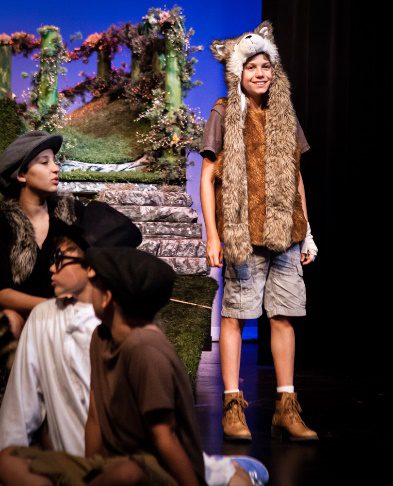
My son as Lost Boy Curly in Peter Pan
The musical counterpart to the Lago Vista Players is the Lake Travis Music Theatre company. Formed in 2007 by Barbara Graham and Bill Parcher, the group produces a well-known musical every summer. Often the cast-size exceeds 50 people and they tend to pick shows that ensure actors of all ages will be able to participate in some way. These days they rehearse after-hours at the Lago Vista Elementary School and perform at the high school’s performing arts center, aka the ‘PAC.’ In 2017, the musical they chose to produce was Peter Pan. Unexpectedly, my son signed up to audition and he brought a fellow 6th-grader along for moral support. I stayed out of sight while he did a cold read and sang an off-the-cuff acapella version of a 21 Pilots song (his favorite group at the time). An odd choice, but the director saw potential and cast him as Curly, one of the Lost Boys. He then joined a youth-based offshoot of the Lake Travis Music Theatre called Rising Stars (a group he had no interest in a year before) and voilà, he was ‘hooked.’ A year later, he had two shows under his belt; the other was a youth version of Beauty and the Beast, in which he played Lumière, French accent and all. In less than a year, he had transformed into a confident and outgoing young man.
In March of 2018, it was summer musical audition time again. This year the show was “Oklahoma!” and Barbara Graham, the director, had asked me if I would be interested in participating, since my son would most likely be in it and my father was going to be directing the music. I hadn’t been involved in a musical since the mid-1980s and my schedule was horrific, but I still agreed to look into it, thinking I could just be a cactus or something.
On audition day, I lurched into the children’s dance studio where the Lake Travis Music Theatre’s auditions are always held, expecting to have a quick conversation about scheduling and then hopefully be able to leave as I was navigating a flu bug at the time. I plopped down in the narrow hallway to await my turn. I could hear a girl singing beautifully through the door to the studio and I was thankful I wasn’t going to have to do anything like that. Someone handed me a clipboard. On the paperwork where it asked what character you’d like to audition for, I jokingly scribbled “Sweeney Todd.” I was not taking things seriously at all. Then it was my turn. To my unexpected horror, I soon found myself singing, doing a cold read and having to dance with the assistant director. I quickly reentered my bed after I escaped and thought no more of it. The next day, my phone rang. It was my father. “Keep this under your hat for now, but Barbara wants you to play Jud,” he told me in a voice that was all smiles.
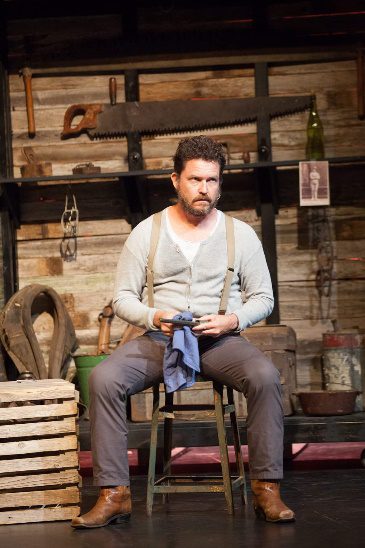
For those unfamiliar with “Oklahoma!”, Jud is the antagonist of the show who is in several scenes (including two fight scenes) and has to sing a forlorn song by himself on stage. It’s a big role, and I’ve never considered myself a crooner. I had a bit of an anxiety attack when I realized the scope of the part, plus I was going to have to break the news to my girlfriend, who was already unhappy about my schedule. My inner accountant was already calculating how much work I was probably going to have to turn down during the week of dress rehearsals and the two weekends that performances are scheduled for. But I agreed to do it. The Lord hates a coward, plus, how many times does one get to participate in a creative endeavor with two other generations of their family? My boy was feeling secure in the theatrical process at this point, so I didn’t feel like I was stepping on his toes, which was an important consideration for me. I didn’t want to do anything to jeopardize his decision to favor theater over running head-first into other kids on the gridiron.
Once the cast was announced, they organized a potluck dinner and a table read where everyone was seated in a large circle. Right away, I was taken aback at how much this felt like a family event, based on how everyone was interacting. As our newly minted cast slowly made our way through the script, I felt like a complete impostor, even though I had cursorily known many of them for years. It dawned on me that I hadn’t yet earned my place in the group, so I resolved to change that.
Me as Jud in Oklahoma!
I grew my first beard in 50 years. I signed up for vocal lessons via Skype from a guy on YouTube. I downloaded Hugh Jackman’s version of “Oklahoma!” (he played the lead, Curly) and put silence where my lines were, so I could virtually rehearse with Jackman in my car or in my headphones on the many walks I take in my neighborhood. I remember on one such walk rescuing a turtle and having to carry him half a mile to the lake while I was rehearsing my lines which made me look like a total crazy person. I lined up a stuntman friend to come out and choreograph the fight scenes, which he did for free, as he liked that I was doing the show with my dad and my son. I never screwed around at rehearsals and tried to set a good example for the youngsters in the ensemble (who were a little afraid of me, thanks to my character being kind of intense). Despite all my efforts, I was hyper-aware that I was playing catch-up with the very talented individuals playing the other principle roles. I was scared and humbled on a daily basis.
I was having to commute back and forth every weekend from a movie I was doing sound on in Houston, but I didn’t mind at all. I found I had fallen in love with the process, much like my boy had the year before. Getting to collaborate on such a project with my newly teenage son without him being resentful of my presence or rolling his eyes was everything I had hoped for. I was blown away by how much talent was in the ensemble, who had been putting in so many hours for no financial compensation, rehearsing for eight-plus weeks on a child-sized stage in an elementary school cafeteria where the air-conditioning might or might not be on in summer temperatures. Because, for most, it was an important, family-centric experience. The teenage girl who was wonderfully playing Ado Annie had been a shy kid, like my son. “Community theater changed my life,” she told me after rehearsal one evening.
With the performances a week away, it was time to move our production out of the humid elementary school and into the performing arts center. I finally felt I had earned my way into the tribe. I was now prepared and addicted.
The two weeks of shows went well, despite one performance when my knife flew across the stage during one of my many choreographed falls (which is why I carried two). It all blew by far too fast and I was left with a big empty inside. It was similar to the feeling I get when I wrap up a lengthy film project as a technician, but it cut a little deeper as a performer. Getting the chance to be someone completely different than yourself is an extraordinary experience. I was also filled with remorse when I realized how many years of opportunities I had missed out on with my parents that had been right under my turned-up nose.
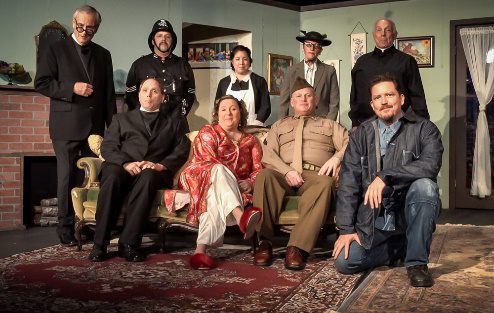
The cast of See How They Run
Making up for lost time, I got cast as an escaped Russian prisoner of war in a Lago Vista Players show called “See How They Run”, a 1940s British farce written by Phillip King. This was my debut with the Lago Vista Players and my mother was directing. After 13 years of spectating at the K-Oaks Clubhouse, I was finally on the other side of the proscenium. Good thing, too, as it was most likely the end of my mom’s tenure as director for the Players. Her eyesight and overall health has dictated that a break is in order. Her former assistant Annie Febbo is directing the Player’s current show, “The Desk Set”, with my mother sort of being her Yoda. I am in this show as well, surprise surprise.
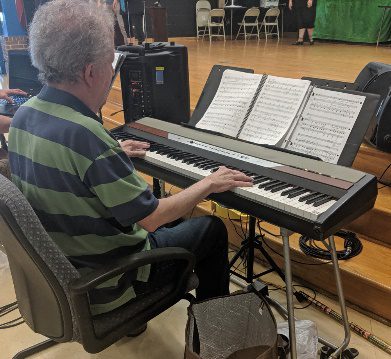
My father at an “Annie” rehearsal
On the topic of failing health, my 75-year-old father (after years of countless tests) was finally diagnosed with Alzheimer’s. This last summer, the Lake Travis Music Theatre produced the musical “Annie”, and it was most likely my father’s last as music director. He had a TIA (a small stroke) at the beginning of 2018 but somehow rallied enough to direct the music and play the piano for “Oklahoma!”. This year has been different. At our first big rehearsal for “Annie” he had to leave halfway through, as he was having temporal dislocations and was unable to keep up with the sheet music. Something that has never happened in over six decades of professional playing.
A month into the process, he drove his car into a ditch after an evening rehearsal, and somehow neither he nor the car was damaged. As a backstop this year, we implemented a computer-based score assist software program to augment his piano and the other two orchestra members, which took a lot of the pressure off of him. When the curtain dropped on our final performance of “Annie”, I breathed a huge sigh of relief, thankful that he was able to successfully bookend such a prolific career. His contributions to the performing arts out here will be greatly missed by the community.
There are some who predict that fine arts are obsolescence-bound. It’s true that school districts are slashing budgets and cutting programs, concentrating on standardized-testing and STEM subjects, but recent Brookings Institute research shows that incorporating the arts into school curriculums can facilitate a better understanding of society, improve communication skills and provide a motivation to stay in school. Community theater facilitates a safe, creative, fun, collaborative and multi-generational learning environment that teaches self-discipline, social skills, respect, empowerment and empathy. Schooling little ones to be a positive component of something larger than themselves is a valuable lesson. Even if they manage to eradicate fine arts programs from public schools, I predict communities will continue to provide them. Every moment I’ve spent with my new friends and family, every memory created in that process has created value that transcends any tangible compensation. While I regret what I’ve missed out on, I’m going to channel Dr. Seuss and be glad I’m currently heading in the right direction with my son.
We are currently neck-deep into rehearsals right now, so I need to go run my lines again. I’ll leave you with an old quote that comes up when people say (like I used to) that community theater is trivial and quaint: “Professionals built the Titanic; amateurs built the Ark.”
The cast of the Lake Travis Music Theatre production of Peter Pan