A Problem With the Problem With Apu

By Sean McCormick

The Simpsons and I have had a near-daily relationship for decades now — it was the only therapy I could afford during my turbulent 20s. The show is both a celebration and an occasionally savage indictment of the times we live in. I owe it my fealty.

Sadly, my beloved show — now heading into its 32nd season — might be missing a familiar face this Fall.

In January 2020, voice actor Hank Azaria announced that he was voluntarily stepping away from the role of Apu after receiving criticism that the Apu character was an Indian-American stereotype being played by a white actor. “Once I realized that that was the way this character was thought of, I just didn’t want to participate in it anymore,” Azaria told the New York Times in an interview.

Indian-American comedian Harry Kondabolu felt so strongly about the Apu character that he made a documentary in 2018 called “The Problem With Apu,” which advocated for the character’s removal from the show.

Apu first appeared on The Simpsons in “The Telltale Head”, which aired in February 1990. Back then, it was hardly a stretch that a convenience store might be run by someone of Indian or Pakistani descent. The overwhelmingly poor response to Kondabolu’s documentary trailer suggested that he might be an outlier. Was Kondabolu’s crusade “wokeness” gone amok or was there substance to this?

One of the main complaints was Azaria’s broadly comical version of an Indian-American accent. In the documentary, actress Sakina Jaffrey described it as “patanking” — to speak English with an exaggerated enunciation that is more an offensive caricaturization than an accurate representation of an Indian accent. Many Indian-American actors have felt cursed with this expectation when trying to find roles to play.

Not everyone wanted him gone, however. Opinion columnist Bhaskar Sunkara was in support of keeping Apu on the show. “Apu was an emotionally developed character, much more so than other Simpsons characters, he cared about his family and worked tirelessly to support them. He was also allowed to be zany and kooky – he wasn’t just there in the background, he had his own plotlines, he was neurotic, unique, not just a prop for diversity,” he wrote in a 2018 column for The Guardian.

Kondabolu’s documentary did inspire me to dig deeper into my own interpretation of his issue with the Apu character. It finally struck me that his generation of Indian-Americans are around the same age as The Simpsons. They are much more mainstream now and many are desperate to separate their hard-won identities from the worn-out Indian-American tropes that they feel Apu Nahasapeemapetilon perpetuates. Tropes that are pretty easy for white viewers to become too comfortable with.

I also realized that The Simpsons have failed to evolve commensurately with the times during its three-decade run. That’s an eternity in American culture. They had over 600 episodes to implement a Darwinian gradualism to the different characters to prevent any of them from becoming anachronisms. By the time the show finally acknowledged there might be a problem, it was too late. Their response to Kondabolu’s claims came across as strangely tone-deaf.

Apu was demonstrably a funny and thoughtful character at times, but his foibles as a stereotype were never at my expense as a white male.

The Simpsons have had a great run, but the show’s been in hospice for a while and there are rumors afloat that it might be taken off of life support after this upcoming 32nd season — with or without Apu.


Some Big Fish in a Small Lago

A close up of a street sign with trees in the background

Description automatically generated

By Sean McCormick

04/19/2019

In 1999, Milton Wright, a now-79-year-old retired African American man and his wife, Helen, moved to Lago Vista, Texas. At that time there were fewer than 40 black people in the entire city. Wright’s reason for moving to Lago Vista was simple: he wanted to retire out in the hills by Lake Travis. “We saw a house we liked, bought it, that’s it,” he said.

In the 1930s, a series of dams were built along the Colorado River to prevent flooding, which created the Texas Highland Lakes. Lago Vista was initially developed to be a lakeside retirement resort on Lake Travis in the 1960s. Eventually it incorporated in 1984 to prevent annexation by its much larger neighbor, Austin.

Having grown up in Waterbury, Conn., Wright is familiar with the small-town lifestyle. He is aware that there is a small minority community in Lago Vista. “I don’t know too much about it,” Wright admits. “When we go to plays, we’re generally the only minority couple there. But that’s not unusual,” he added.

According to 2017 Census data, of the 6,815 people currently residing in Lago Vista, 3% are black. This is less than a fourth of the national average of 13.4%. Texas overall, has an average that is more in line with the U.S. at 12.7%. Lago Vista placed 13th as “whitest city” in Texas, according to the rankings site RoadSnacks.

Andy Cox and his husband Darrell reside in a Lago Vista census-wrecking household: a white, same-sex, married couple with three minority foster children comprised of two black girls and one Hispanic boy. Last November, their black foster daughter, Ke’auvia, moved to Lago Vista from Temple, Texas, which is 17.3% black. She is the only black girl in her fourth-grade class at Lago Vista Intermediate School. Cox feels the transition to the new school went smoothly for her. “There have not been any racial issues, no tension. They were lined up at school to welcome her once they learned she was coming. I think it’s been more awkward for me. I’m noticing that she sticks out like a sore thumb, but she doesn’t seem to notice it.”

Wayne Woodall, a white, 70-year-old forensic engineer who moved to Lago Vista in 2014, has had a similar experience. His daughter, whom he adopted from Mexico and her daughter, Angie, who is half-Hispanic and half-black, moved from Houston to live with Woodall and his wife last year. Houston’s black population comprises 23% of the city. Like Cox, Woodall felt the transition went well but was a bit jarring at first. “It was kind of a shock for my granddaughter, coming from Houston. After her first day at school she said, ‘I’m the only black kid here.’ She’s been accepted really well and made a couple friends. She didn’t experience any bullying or anything,” he said.

After almost 20 years in Lago Vista, Wright has no regrets regarding his decision to move to the area. “I’ve never really encountered anything that would discourage me from being out here. It’s been a pretty friendly town. All our neighbors we know. It’s always been very cordial. Friendly people,” he said.

A large body of waterDescription automatically generated
An overview of the city. Photo: Sean McCormick

The cause of the demographic disparity is difficult to pin down. Lago Vista is not reminiscent of an old “sundown town” of yesteryear, like Vidor, Texas.

Ann Murrow, a Lago Vista real estate broker and founder of the Lago Vista Women’s Club, insists that the lack of diversity in Lago Vista is not by design. “It’s a federal law that you cannot redline anybody out of a community. That happened in the 1970s. No more,” she said. Redlining is a procedure where real estate agents selectively show — or don’t show — homes in specific areas. The Fair Housing Act of 1968 was created to prevent such discriminatory real estate practices.

Wright suspects it may be a combination of things. “At one point this was designed to be a suburban community for seniors. It doesn’t really have any economic development for serious employment,” he said. Wright’s commute to work before he retired got up to 50 miles per round trip.

City Manager Joshua Ray also suspects employment is an issue. “The job market in Lago Vista is not as strong as in other communities that may have larger populations. The drive on 1431 to Cedar Park, Austin, Round Rock, Leander, Marble Falls and other regional cities is not great in distance but could be seen as a possible deterrent to some people that do not enjoy driving on a hill country road,” says Ray.

Wright feels that being different in a community can be an opportunity. “I have a theory, that we’re communicating more, we’re not as separated as we were in the old days. There was always what people thought other people did. Now you know that they aren’t much different than you. You’re not isolated. Out here, the fact that you’re the only kind of a particular ethnicity doesn’t really matter at all,” he said. “After a while the differences melt away.”


Lago Vista High School chooses to coexist with smartphones despite hurdles

A no-cell phone warning sign outside a Lago Vista High School classroom
A warning outside a Lago Vista High School Classroom

By Sean McCormick

Jim Ed Baugh, who teaches the Lago Vista High School audiovisual program, recently noticed one of his students taking a picture of his math homework with an app on his smartphone. The app then solved the math problem, based on the image.

At Lago Vista High School, despite the no-cell phone flyers posted outside the classrooms, teachers are allowed to make the call whether to incorporate smartphones into their curriculums, which has created some challenges.

Lago Vista’s first school was a single-teacher, one-room affair, established in 1895. If there was a student handbook back then, it was probably nothing like the 144-page document that currently exists. According to the 2018-19 Lago Vista ISD Student Handbook, “In some cases, students may find it beneficial or might be encouraged to use personal telecommunications or other personal electronic devices for instructional purposes while on campus.” Students must obtain prior approval and sign a user agreement in order to bring a smartphone to school.

Some students struggle with self-control during class. Communications teacher Steve Garcia once caught a student watching the television show Grey’s Anatomy during his lecture. If a student appears to be having difficulty paying attention, the device is taken from them. If it ends up in the office, it costs $15 to get it back.

It’s not just television shows that are diverting attention. Social media can also be a distraction for young people throughout the day. According to computer science teacher Rebecca Holt, Snapchat and Instagram are the two most popular social media applications at the high school. Holt recalls asking some of the girls in her class, “How many pictures can you take of yourselves?”

Smartphone use has also made it into the 504 plans which accommodate students with special needs. Garcia has one student who is allowed to play video games on his smartphone as part of his 504 plan. This required Garcia to explain the situation to the rest of the students, so they aren’t resentful or confused. “We talk a lot about the fact that equal is not always just,” he said.

Regarding whether smartphones in the classroom are affecting student performance, Baugh is unsure. “It’s hard to tell if devices are having an effect on test scores because it’s too difficult to establish a control group,” he said. According to technology teacher Heather Womack, student’s personal device ownership is over 90%. In 2018, Professor Arnold Glass and graduate student Mengxue Kang conducted a study with students at Rutgers University that utilized control groups. They concluded that test scoring and the ability to recall information was higher without devices present.

Figure 1: Arnold L. Glass & Mengxue Kang (2018): Dividing attention in the classroom

History teacher Scottie Johnson feels students need to learn self-control while they are still in grade school. “Before the web, there were kids who weren’t paying attention: they were writing notes, they were doodling, they were staring at a wall. I don’t think devices turn good students into bad students. The kid who is off-task is going to be off-task, no matter what. I liken it to, as an adult, you have to learn how to sit next to cake. If everything’s locked down in high school, when they get to college it’s novel and potentially costly,” she said. Glass disagrees. “It is obvious to anyone who has stood in front of a class that watching a video on a cell phone is qualitatively different than doodling or staring at a wall because it is much more interesting and absorbs much more of the student’s attention,” he said.

The school district has been pressured by parents to allow phones into the classroom. There are working and single parents who want to be able to relay scheduling issues, even though the students have access to email via their school-assigned iPads. According to Garcia, Womack, Baugh and Holt, some parents are abusing this communication convenience. Parents will call and text during classes about non-essential issues, putting the students in a bind, and they then request permission to either answer a text or take a call in the hallway. According to recent Lago Vista High graduate Zoe Schneider, “A lot of parents think they’re above the school system. My parents would text me during the day, but I would only respond between classes.”

These issues aside, most faculty at the high school feel a ban on smartphones would be impractical. Baugh doesn’t feel eliminating the devices is the answer. “Just like prohibition with alcohol, kids are going to find a way around it. It’s just denying the inevitable. Before, teachers would be like, ‘You’re never going to have a calculator on you all the time.’ Well, now you do. Better to get out in front of it and try to control it, use it purposefully. Let them (the students) use it as a source of information,” he said.

The State of Texas Assessments of Academic Readiness or STAAR Test now allows students to listen to music without lyrics using earbuds or headphones as a focusing device while test-taking.

Lago Vista High School Principal Heather Stoner is optimistic. “I don’t see the difference today being as much about the technology as it is about collaboration. Coming to consensus, working together and communicating. All those soft skills are just as important as the academics. I think today’s kids are awesome. I think about who I taught 20 years ago, these kids are just better problem-solvers and thinkers — just great to be around. The kids now are interactive,” she said.


Culture Clubs

By Sean McCormick

My biggest takeaway from this class regarding culture is that cultures are dynamic. No matter how remote the village, so long as humans are involved, societies are going to inevitably change. Also, no one person can possess their own individual culture. It’s a group effort. In the late 1990’s, during the height of the tech boom, I regularly attended the South by Southwest Interactive conference in Austin, Texas. The keynote speaker in 2000 was the now-defunct company Macromedia’s CEO Rob Burgess. He began by showing a clever music video (that utilized their Shockwave animation technology)—a parody of the Buggles song, Video Killed the Radio Star. It was called, appropriately enough, Internet Killed the Video Star.

It was a reminder that our culture was being shaped right in front of us, almost in real-time. During his speech, he used the concept of a culture wheel to describe the rate of social change in different countries. A country like Afghanistan has a wheel that moves so slowly as to be almost imperceptible, while in the good ol’ USA, ours is rotating so rapidly it has become a blur. That analogy has always stuck with me. The evolution of women’s rights in Iran, shown in A Separation, is a good example of a traditionally slow culture wheel being sped up. 50 years prior, a woman like Simin would not have dared to make such assertions regarding the family.

Dictionary definitions tend to allude that culture is a man-made concept, but I began to consider our animal friends. I think it could be argued that they also have their own social cliques and traditions, instinct or not. I recall working in Costa Rica a few years ago and having a howler monkey as an alarm clock every morning. I was told there was a good chance he was an ostracized former alpha-male of his troop. I’ve been that guy before.

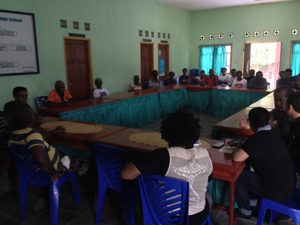
Figure – Surreal, impromptu town hall meeting

I am fortunate to come from a family who considers travel an investment. Leaving one’s community to visit others is truly the best inoculation for ignorance and exceptionalism. My parents, who are in their late 70’s and falling apart, are still dragging themselves to exotic locales.

My brother is the Executive Vice-President for Academic Affairs at EF (Education First), a global language training company. He and his husband, who is a high-level British diplomat, are constantly all over the globe.

While I don’t have their frequent flyer miles, I have been lucky enough to participate in a few documentaries that have taken me to rural Rwanda, Europe, and to islands and villages along West Papua. Getting to experience unvarnished local cultures is vastly different from stepping off a cruise ship to the sound of steel drums and panhandlers. I’ll never forget landing in several remote Indonesian villages by speedboat and clumsily trying to shed my hiking boots (no one wears shoes indoors as a Muslim custom) while laden with audio recording equipment that is running so I can respectfully slide into a teeny dwelling.

Some village elders once convened an ad hoc town hall meeting (that we had to attend) to decide if we were welcome or not, (we were trying to locate escaped fishing industry slaves) and it was awkwardly fascinating. They were protecting their culture as they saw fit. We were always very careful to have the blessing of the powers that be at every destination. John Allen Chau should have done the same.

In 2003, when the supergroup boy-band of Bush, Cheney, Wolfowitz, and Rumsfeld embarked on their Shock and Awe tour of Iraq, we got a firsthand look into what it looks like when one culture attempts to impose its mores upon another without doing its homework first. It was a cultural train wreck. The equivalent of treating a hornet’s nest like a piñata, then complaining about getting stung. There was zero pre-production effort done to examine the cultural balance between Sunni and Shia, and what the fallout might be once the Iraqi military was furloughed.

As a cultural anthropologist knows, you should study a culture’s customs and languages as much as possible prior to strolling into town. When I convinced Dell Computer to hire me as a tech support rep in 1996, it was like being on another planet culture-wise. Thankfully, I had six weeks of training that helped me acclimate to the different lingo and customs before they threw me to the wolves.

Power can be both a culture’s brake pedal and its accelerator. As the U.S. is capitalism-obsessed, the money-changers—enabled by technology—have essentially cut the cultural brake lines. Thanks to the tech advances of the Internet Age, our cultural norms change so rapidly that it has led to the creation of what some call the Slow Movement. A cultural plea to downshift the gears and reconnect to family, food, and life itself.

It has become difficult to quantify exactly what our culture is anymore, much less defend it. Even a country like China, whose culture is carefully guarded and maintained, won’t be able to stop the relentless march of progress. One analogy I came across was that culture is an object on a blacksmith’s anvil. Seemingly solid and intact. Power is the use of the blacksmith’s hammer on that object.

Culture and power are inseparable. Every film we watched during the class showcases some form of a cultural power struggle. Some thoughts I had on power and culture in a few of the films include:

  • Spotlight – the Catholic church leveraged its considerable organizational power to attempt to maintain its status quo. They and those aligned with them claimed their good deeds far outweighed the rogue actions of a ‘few bad apples’. Unfortunately for them, the Boston Globe was able to apply its own organizational power to bring those transgressions to light.
  • Reel Injun – American movie culture celebrating the conquering and extinction of another culture. Watching those school children view people that looked like them being massacred was rough.
  • Kitchen Stories – A nice little example that no man is an island, that there is a hard-wired need for interpersonal connection. When they finally blew off the formality of the study, I enjoyed their discussion about nuclear technology and boiling potatoes.
  • Do you Speak American – I loved the game-based empowering tactic that the schoolteacher utilized to engage his students while they learned to code-switch without shame.
  • The Split Horn – Paja’s Laotian culture empowered him, it was as much a part of him as his hearing or eyesight. His children finally acknowledging that which mattered so much to him was a nice turning point in the film.
  • I am not your Negro – In 1948, James Baldwin chose to shut out the racist and abusive American culture by relocating to France. Early on in I am not your Negro he realized others back home were doing their part to change the dysfunctional American culture and it was time for him to do his. It must have taken a great deal of individual power to return to the U.S.

The late, great comedian Bill Hicks had a bit about our evolution not ending with humans growing thumbs—that ideas need to evolve as well. That many of our institutions and customs are no longer relevant. The U.S. could use a little cultural evolution booster-shot right about now.


NYT Memo Assignment

By Sean McCormick

September 19th, 1963

Dear President Kennedy,

We are nearly finished preparing your speech to the United Nations. I apologize for the delay, but there have been ongoing developments this past week that have required some eleventh-hour additions (and a couple of corrections). The nuclear test ban treaty, which the Senate will hopefully vote on Monday, appears to be moving forward as planned. Rusk will be in touch later this afternoon regarding it, by the way. I do have a few updates about the treaty, which I will address shortly, but for starters, here are a few other issues of concern.

As you are aware, this has been a difficult week domestically. Birmingham is still in chaos. One of the girls, Carole Robertson, was laid to rest yesterday. The current victim count is now six; in addition to the four girls slain in the bombing, two Negro boys were killed during the following protests. I have been getting updates from Assistant Attorney General Marshall, as well as the FBI a few times a day since the attack. Still waiting to hear if Birmingham P.D. is going to entertain his suggestion of appointing Negro police officers to help in the neighborhoods. There are still no suspects in custody regarding the bombing.

Wallace doesn’t appear to be handling the situation (which you can argue he helped bring about) appropriately, the DPS troopers are creating an incendiary environment. Your brother claims we have no jurisdiction in the matter, but I urge you to encourage him to explore some alternatives to the current status quo. It seems unlikely Mayor Boutwell will be able to defuse the situation alone. Our desegregation efforts are going to be set back indefinitely if we don’t act soon.

Regarding our ‘issue’ in Asia, there has been some discontent within the diplomatic corps with your reluctance to take a personal stance regarding the removal of Nhu. Ambassador Lodge is very keen on moving forward with this as Buddhist protests are becoming more frequent. The day before yesterday, a monk in Paris penned a petition to Secretary General Thant using his own blood! Let’s hope there isn’t another Thích Quảng Đức around the corner.

The U.N. is making an effort today to include debate regarding these human rights violations in South Vietnam. We are encouraging the U.N. to allow To Ngoc Thach, the acting observer representing South Vietnam (his predecessor, Mrs. Tran Van Chuong, quit her post in protest recently) to speak regarding the situation. The assembly will have to ultimately make that call, as it isn’t normal to allow anyone from a non-member state to speak. We expect they will allow it, however. No matter how things shake out, the removal of Nhu (and perhaps, Diem, eventually) may create a whole new slew of issues, should their replacements be even more difficult to deal with, as hard as that is to imagine.

This year, the Apollo budget lands at around 2.5 billion dollars. Since 1958, the budget has almost doubled every year, and if my sources are correct, four percent of total federal spending will be put towards the program next year. I don’t see how this growth is sustainable. Public will for this project (as well as Congressional) is already tepid and may run dry soon. I realize this is very last-minute, but I urge you to revisit the Bundy memo from last year (attached). This may be an opportune time, with the success of the implementation of the hotline and the ongoing treaty talks, to reach out and again suggest that a cooperative approach to space exploration may be mutually beneficial. Continuing to go it alone will be a huge financial battle for us.

Despite the obvious technical hurdles of equipment compatibility, there are areas in which each nation can take a lead on. An end result of two flags successfully placed on the moon would be an iconic image and metaphor for world peace and global cooperation. We feel the timing is right for this. While Khrushchev has had a public stance in the past that it wouldn’t be practical, we have intel that he may actually be amenable to such a proposal now. With your permission, we’d like to go ahead and include a passage in the speech tomorrow that revisits the issue.

Regarding the test ban treaty, a bit of good news to start with. It’s looking favorable that it will be ratified without any amendments per Senator Carlson. Thanks to Douglas and Jordan changing their tune there’s now the necessary two-thirds required. The Joint Chiefs aren’t completely happy, but they’ll be on board.

Goldwater’s registered a reservation regarding demanding Soviet withdrawal from Cuba, but Fulbright has every expectation it will find defeat should it reach the floor. Dodd has filed five understandings, but he is expected to remove them based on your prior assurances. On Tuesday, Senator Russell, predictably, was making claims that the treaty puts the U.S. on a path to unilateral disarmament. He also bemoans the lack of content regarding inspection, plus he remains a doubting Thomas about the chill between Peking and Moscow and maintains that the Soviets are ahead of us in a nuclear capacity. He knows his chances of thwarting Fulbright are slim to none at this point, however.

You hear what Senator Miller (who was wavering, but now is reluctantly on board) recently said on TV? He made a claim that should the Russians sign off on this that it might help you win in 1964. Senator Pastore, chairman of the Joint Committee on Atomic Energy made a great speech regarding what would be left behind if we didn’t act now and allowed a holocaust to occur.

The American Legion, who has been hammering us on the situation in Cuba, has agreed to endorse the treaty with a few reservations: The U.S. may continue legal nuclear testing and remain prepared for the resumption of atmospheric testing should another party violate the treaty, our sovereignty remains intact, and this is not to be a step towards total U.S. disarmament. As all of these stipulations have already been addressed, it’s safe to say the Legion is on board.

There’s been several reports of anti-treaty propaganda being mailed out in the guise of correspondence from legitimate-sounding organizations that we have no knowledge of. Senator Aiken of Vermont claims his mail has been 60 percent opposed to the treaty, yet the anti-treaty mail was all postmarked from Texas and California. He said eighty percent of his treaty-related Vermont mail has been pro-treaty.

Were you made aware of Governor Rockefeller’s claim two days ago that we are just shaming our allies into signing? He also said unemployment will go up from 3,800,000 to 9,000,000 by 1967! On a lighter note, as of Tuesday, we caught a big fish, San Marino, a little postage stamp in Italy. They became the 94th nation to climb aboard. On Wednesday we also added Togo and Tanganyika, which got us to 97.

All said, the general consensus is that we are making a great step forward in the quest for peace between our fellow global citizens. It is my recommendation we allow the current version of the treaty to move through ratification as-is, then we can revisit the issue of inspections and some of the other reservations when appropriate. We will hopefully have your speech delivered later this afternoon. Best of luck at the U.N. tomorrow!

Respectfully,

Sean McCormick


Digital Winter is Coming

By Sean McCormick

Many industries experienced a golden age prior to the internet, but the sudden capability to turn once-tangible products and services into a series of 1’s and 0’s, rendered many companies obsolete, or at least ill-equipped to remain competitive. I had a front row seat during one such transition. This paper provides an overview of what my life was like in a relatively nascent multimedia department at a large educational publisher, featuring a peek at an incident I witnessed immediately upon being hired, a good early example for me to observe regarding how disconnected our department was. It was also a metaphor for how this company (as well as other educational publishers) operated in general.

The Biz

Holt, Rinehart & Winston was a 6th-12th grade educational publisher with roots going back to 1866. They were acquired by Harcourt in 1985. While they offered most disciplines, Language Arts was their wheelhouse. There was a saying at Holt, “nobody ever got a trophy for saving this company money.” Prior to the internet intruding, this was true. When Holt had a good adoption cycle, it was very good. There were three regions that decided the fate of textbooks nationally back in the day, New York, California, and of all places, Florida. HRW’s culture was rabidly book-based, as their book sales were what filled the coffers. The encroaching internet was largely viewed as a nuisance. This wasn’t a Holt-specific attitude, all the other players (McGraw-Hill, Pearson, etc.) were cooling their heels as well, waiting to see what the competition would do. It became a pretty high-stakes game of chicken.

Ch-ch-ch-ch-Changes

Around Y2k, I had decided that the IT world I had been toiling in was a bit dry for my liking and I wanted to find something more multimedia-adjacent. My fiancée at the time was a short, blond, pit-bull of a QA supervisor for HRW, who frequently traveled to the U.S.-based printing press locations (it’s all done in China or Vietnam these days, I believe) to make sure the books were meeting specifications. In the spring of 2000 there was an opening in their multimedia department and she managed to land me an interview. This interview was unique for me, as I had zero idea what the job title was, let alone any other details, i.e., duties, salary, etc. With chutzpah as my co-pilot, I met with two multimedia department supervisors in a nice conference room. I plastered on my best immigrant smile and nodded dutifully at their opening salvos until it became clear what it was they were looking for – a low-level web monkey to assist the marketing department with updates to the corporate web presence. Thankfully these two were more of the project manager stripe and had near-zero technical knowledge of anything internet-related. While I had no professional web-development experience, I had dabbled a bit and knew enough jargon to keep them at bay. Having done time at Dell and a small software company helped me clear their hurdle, and it didn’t hurt that I was engaged to someone in the organization. The next step was a technical interview, which was scheduled for a week later. This was a terrifying proposition, as I would not be able to BS my way through that. I resolved to simply try to make the case that I am a quick-learning self-starter, which was true enough, I had taught myself enough to go into tech support and IT work a few years before. My fears wound up being for naught, as the developer I met with was pretty jaded about the company and spent the entire 45 minutes bitching about the place. I received an offer letter a few weeks later and was slated to start June 7th, the week after my honeymoon cruise. I spent an hour a day on the cruise frantically studying an HTML book in a Hail-Mary attempt of preparation. Upon arriving for my first day of work, I learned that the guy who gave me my “tech interview”, and who was supposed to be my Yoda the first few weeks, had left the company. This was during the tail end of the dot com boom and I found out several people had left Holt during these days, where you could have the words “flight risk” watermarked on your resume and someone would still hire you. It was a real testament to the perceived fecundity of the computer boom era that several HRW employees had abandoned the notion of changing HRW’s rigid caste culture to the point of giving up perfectly good jobs to attempt to create their own via startups. A few of them would come crawling back over the next few years (including my ersatz Yoda), which I will revisit in a bit.

New Toy

Several of the denizens of HRW’s multimedia department were old-school broadcast TV folk who had a pretty limited grasp on digital technologies, which kind of led to the equipment-purchasing decision that is the crux of this paper. Right before I began working at HRW, the multimedia department decided to allot money for new equipment to capture, transcode, and repurpose legacy video content. We had many ancillary videos that resided on Sony Betacam tapes (and DigiBeta) that would eventually be needed to be available on the web. The person in charge of selecting the hardware/software for the upgrade had also left before I got hired, so I had missed out on the chance to chime in on the upgrade items, as I had been dabbling with capturing and streaming video for a few years already. They had linked up with a local hardware vendor who happily provided the costly gear and performed the installation. The total cost wound up being over $40,000 dollars! A large line item indeed, but as I mentioned previously, no one got a ribbon for keeping costs low back then. What was unfortunate was that the “solution” was way off from being the right one, and by the time we (the folks tasked with actually using the equipment) realized this, it was too late to hit the undo key. What arrived was a beefy (for Y2k) Apple G4 tower, with Avid Xpress non-linear editing software, Sorenson transcoding software with an ICE board for optimizing video transcodes, a couple monitors, a Sony DVCAM digital video deck, a Canon XL-1 DV camera and a nice patch bay for interfacing all of the above, in addition to our older Sony Betacam SP decks. Good stuff, if you are wanting to head back out to tape for broadcast, but woefully inefficient for large queue transcoding purposes. As I previously mentioned, TV people, not digital folk were running the rodeo back then. Working with video back then was tricky due to the high processor and memory usage, commodities that were still very expensive at the time. We wound up spending a wildly inordinate amount of time attempting workflow workarounds, while our render queues were stacking up due to the glacial output pace. We went round and round with the equipment vendor, looking for ways to make life easier, largely to no avail. Spending any more money was out of the question, so we were going to have to make due with our $40k albatross. To use author Robert Putnam’s terminology from Bowling Alone, deprecations about the configuration eventually devolved into derogations. My colleague’s account of what happened included the perfect foil, the employee who chose all the equipment no longer works there (Putnam, 2000).

Dance Dance Evolution

Wait, I was supposed to just be a web-monkey at that company, right? How did I wind up involved with video issues so early on? As I was an orphan upon arrival, thanks to no longer having a mentor, the village did their best to raise me, but everyone was stretched a bit too thin to be much help. As someone well-acquainted with the rigors of secondary socialization, I was pretty comfortable bootstrapping myself into the fold. My wife at the time (now ex) used to kid me about how it seemed I was always paying dues somewhere, which is pretty apt, as I’ve been blessed/cursed with so many interests over the years. I’m certainly a believer in earning one’s spurs, regardless the size or complexity of the organization. Becoming multistranded with fellow employees is usually a first priority, whether it’s attending a company-created team building event or creating one out of whole cloth myself by throwing a party (which I’ve done a few times). Coed softball leagues work great as well. The resulting social capital can be invaluable when times get rocky. This lack of direct supervision gave me some latitude to seek opportunities that weren’t initially advertised. My weekly marketing meeting and the website copy corrections that I was tasked with only ate up about 40% of my available bandwidth. Things got a bit more challenging when the design team started giving me layouts to make web-friendly and I had to quickly figure out how to make Photoshop and Macromedia Dreamweaver play nice together. Once I learned how to keep my web wolves at bay I got involved with our video transcoding conundrum. I had more current digital media chops than my colleague there (another broadcast video vet) so no one groused about me putting in my two cents regarding the new workflow issues. To invoke Putnam again, my Johnny-came-lately diagnoses of the situation met a quick and painless death, as nothing was going to be altered at that point, plus with me being such a noob in the company any formal complaining about it would be heretical at best (Putnam, 2000).

Failing Upward

Our department’s “manager” was a fantastic introduction to the concept of the sacred cow in a corporation. I learned there were several such “cows” in the company pre-Y2k, before everything caught on fire. He was famous for either filibustering through meetings or being completely checked out and just repeating a couple things others said at the end. I peeked into one once and he was just staring blankly and digging into his ear. At least once a day he’d corner someone in their cube just to talk their ear off, amazingly one-sided conversations that were completely irrelevant to the business at hand. We had a standard procedure, if anyone noticed a colleague being pinned in by the boss, we’d call the captive’s phone and tell them they were needed in the front lobby. Nine times out of ten this technique was successful in extricating them. He also borrowed the department’s brand-new video camera to film another sacred cow’s daughter’s softball pitching audition for her college application and managed to get a fast pitch right in the eye for his troubles. Our first question upon seeing him the next Monday with a black eye was, “is the camera ok”? I put his filmed mishap to music and that video clip was super-popular amongst the rank and file for a while.

The Salad Days

The expensive addition to our multimedia equipment arsenal was a decent metaphor for the corporate culture at the time. More $$$ than sense. It wasn’t just our department, or even our company. All the large publishers at the time were giving away jaw-dropping amounts of gratis materials to try to curry favor with school districts, a crazy race to the bottom approach to success, instead of making the digital world a company-wide priority. While the lack of specific technical expertise in our department caused some ongoing headaches, it provided me a fertile playground in which to try out new and interesting technologies in a corporate setting. Before the company’s looming troubles began, they were sending various personnel out to Ojai, California for training in Macromedia products at Lynda.com’s classroom facility (back when companies had budgets for such things, I would say the vast majority of Lynda.com’s business is all online these days), whether it was necessary or not. This included staying at the Ojai Valley Inn and Spa, of course. I got to go on one of these junkets at the beginning of 2001. Some of us also got to attend DV Expo, a digital video training-based trade show that was based in Los Angeles, for a couple of years before things dried up. While it was costly to send a few of us, these were actually inspirational outings, getting to learn techniques from the actual folks who wrote the book on things, like Chris and Trish Meyer teaching Adobe After Effects and hearing about DVD authoring directly from Jim Taylor. I came back from these experiences really jazzed up and I’d immediately harass my managers to think about adding new services for the department. These company-funded perks would qualify for what Putnam refers to as human capital, “tools and training that enhance individual productivity” (Putnam, 2000).

New Digs

All good things come to an end (or get outsourced). HRW and its clumsy parent company, Harcourt, was acquired by global publisher Reed Elsevier in 2001. This occurred right as we were making the move to a fancy new building in North Austin. This was a huge deal as everything and everyone suddenly wound up under a new level of scrutiny. This started our company’s culture wheel to turn at a faster speed than was comfortable for most. Right before the move, some of the aforementioned sacred cows found themselves to be endangered species. Our dubious leader was amongst the first to go and one of our mid-level managers was put in charge temporarily. A nice enough fella, but still pretty unaware of what exactly a few of us did. I decided the move to the new building was a huge opportunity to make some Madonna-esque reinventions for myself. The corporate website was really outdated and needed a major overhaul, but the process to transform it involved too many decision makers so it kept stalling out. I requested that the AV room in the new building have an enclosed space with a glass window to use as a vocal booth for voiceover, and happily it was approved. The person in our department that had been project managing all the voiceover work at foofy studios in Austin and abroad was none too happy about this addition, and initially tried to thwart it, but I made it clear we were only going to do light lifting with it: glossaries, world language stuff, etc. so the editors could come and knock out stuff without having to go offsite. The heavy stuff, like textbook narrations, etc., would still go to the big boys, and those line items were six-figure doozies every year. Alas, we were still stuck with our $40k “investment”, however. This would change soon enough.

Meet the New Boss, Same as the Old Boss…

Once we were settled in the new campus, we finally got a new manager to go with it. Actually, she was the old manager who had left to form a startup company during the boom prior to my arrival at HRW. She was held in much higher regard than the previous fella and one of my first encounters with her involved her having to settle a weird turf war over the marketing website I was involuntarily having with a couple of the marketing folk. It was nice to know she had my back from the get-go. While she wasn’t terribly technical, she did understand how the company functioned and was pretty hands off with those she trusted. She hadn’t been there when the department blew all that dough on the previously described “upgrade” so the timing was perfect to request a proper slew of toys for the new facility. I made a thorough, well-researched, well-documented case for the additions and got it all approved! We switched from the Avid world to the Apple Final Cut Pro one, acquired hardware and software to begin rolling our own DVDs and a couple of decent microphones and hardware to run Pro Tools for our new onsite voiceover services. I had a colleague who pre-dated me by a couple years at the company who shared the AV room with me and we were suddenly able to take on and deliver way more project offerings than when we had been previously able to.

Last Call

This era of growth for us lasted a good few years until our European overlords Reed Elsevier got frustrated with the erratic financial cycles that educational publishers have. It was always a mystery to me that they didn’t seem to realize that financial growth in the educational publishing space isn’t some easy-to-chart linear thing. They eventually gave up and began the process of trying to sell us out to an Ireland-based tech company and the outsourcing and the bloodletting began in earnest around 2007. The impending sale certainly achieved the unintended goal of busying “giddy minds with foreign quarrels” (Weeks, 2003), in fact, we were so giddy that a huge chunk of our time was spent polishing resumes and attending surreptitious job interviews. In describing the concept of oscillations, Meadows writes, “this situation of information insufficiency and physical delays is very common. Oscillations like these are frequently encountered in inventories and in many other systems” (Meadows, 2008). Employee uncertainty causes oscillations within many elements of a larger system that can directly affect productivity and diminish various types of stock. Our department lasted longer than I had imagined it would, but in August of that wonderful year 2008, our entire group was let go at the same time. The HR folk tasked with showing us the door were all crying. The hubris of the old sacred cows, all being in denial of the information age, finally had come home to roost. Back in the 1990s, not one of the educational publishers wanted to lead in the digital realm, which ultimately wasted a lot of resources and money trying to play half-assed catch-up, as whoever could have planted a robust e-learning flag first would have created an enormous advantage, and I might not be typing this now. The music industry also paid dearly for their denial back then and is now a shadow of its former self. An enlightened developer in our group said back in 2006, “We’re on a ghost ship and no one realizes they’re dead.” He was only off by a couple of years.

References

Terkel, S. (1972). Working. New York, NY: The New Press

Meadows, D. (2008). Thinking in Systems: a Primer. White River Junction, VT: Chelsea

Green Publishing Company

Putnam, R. (2001) Bowling Alone. New York, NY: Simon and Schuster

Weeks, John. (2003) Unpopular Culture. Chicago, IL: The University of Chicago Press


Projection

By Sean McCormick

Until I was about 26, I was a pretty lousy student. I had zero ability to fake an interest in that which didn’t strike my fancy, which led to many appearances of “I” and “W” on my transcript. That being said, every so often a class would come up that did float my boat, and I tended to get an easy “A” in those. In 1992 I had signed up for an audio production class. I had been drumming in bands since I was 14 and already knew my way around mixers, recorders, synths, drum machines and microphones, but had very little understanding of actual audio fundamentals. This class was going to not only provide said fundamentals, but also allow the class access to an actual professional recording studio for our labs. We would also get to use a real band as a guinea pig. I was finally looking forward to going to class!

On the first day, we met at the Austin Community College Rio Grande campus. We were slated to be solely in a classroom the first few weeks while we learned factoids about the speed of sound and argued over whether a tree falling in the woods actually makes a noise if there’s no one around to hear it. I think all of us were eager to quickly get through the book work so we could play with some expensive toys. We went around the room making our introductions, and eventually got to this one small, brunette girl, she introduced herself as Mary. I hadn’t really noticed her up to that point, but it quickly became apparent that she was blind.

I was pretty stunned by this. If you’ve ever been in front of one of the larger mixing consoles, they are intimidating pieces of furniture. Sometimes hundreds of knobs and faders, phantom power switches, buttons, input and output jacks, lights, VU meters, with numbers etched into everything. Then there’s all the outboard gear that connects to the mixing board: compressors, delays, reverb units, speakers, complicated patch panels, lots of different cables, the actual reel to reel recorder and its accompanying remote control. And that’s a pretty basic description. There’s many other gadgets and peripherals that I won’t bother to list. I was having a major ‘does not compute’ moment at the idea of not being able to see all these components while working with them. Speaking of computing, the World Wide Web had not yet been mass deployed in our schools, so this would have been sans any sort of computer assistance. Recording technology these days is almost all computer-based, save a handful of Luddites who still prefer the “warmth” of actual tape saturation and analog outboard gear versus the digital simulations that pervade the landscape. All at once I felt pity for her situation (that I knew nothing about), incredulity that someone would attempt this kind of a class, annoyance that this was probably going to be a headache for the instructor, and some remorse for the annoyance. Admiration for someone being brave enough to explore an interest, despite the obvious challenges, hadn’t occurred to me yet.

Our instructor’s name was Andy. A very friendly and cool fellow. He did not allow Mary’s condition to affect him outwardly in the least, but initially I surmised he must have been internally flummoxed at the notion of navigating this girl through the myriad of buttons and blinky things that come with the territory. I figured he hadn’t factored this scenario into his lesson plans before. It took a lot of restraint not to quiz him about the situation after class, it just seemed like such a conundrum.

The classroom portion went just like any other class, we had material to read and quizzes to take. Finally, it was time to venture out into the world. The college had an arrangement with an analog studio called Longhorn Audio. It had a decent-sized mixing console in the control room which recorded to a 24-track recorder onto 2” magnetic tape. Andy spent the first few sessions familiarizing the class with the gear and workflow; no sense in wasting the band’s time just yet. Reggae local Papa Mali had been recently doing some recording there, so we got to use his material to fool with. Our instructor kept Mary right by him so he could easily point out the different tactile surfaces of the equipment. Her participation didn’t noticeably attenuate the rest of the class’ experience in the least. Nor did she seem overwhelmed, she had the same friendly positivity she had possessed in the classroom and was truly enjoying the new surroundings. Another couple of weeks rolled by and it was time to bring in the band. They were called Apaches of Paris. Mary had obviously not been around rock musicians much, it was fun to watch her discover what loons they tend to be. She laughed a lot during that session.

At this point I began to feel pretty stupid and ashamed about projecting my own lack of imagination onto her from the beginning of class, as well as my unfounded assumption that the instructor was probably unhappy about the extra burden I perceived to exist. My early 20’s and empathy didn’t intersect too often. Like in the Adichie piece, I had ‘single-storied’ Mary. Yes, if she had decided to choose recording engineer as a career she was going to have a lot to contend with, but that didn’t stop Rick Boggs, a successful producer/engineer who is a featured professional in the American Foundation for the Blind. In 1996 the International Society of Blind Audio Engineers (ISBAE) was founded. She had every right to be interested in and pursue music recording, regardless of the hurdles. My takeaway from that experience was that just because I may struggle to make sense of someone’s situation, that doesn’t at all mean they do. It’s healthy to be aware of limitations. Just don’t invent them…or assume them.


The Moving Target of Advertising

By Sean McCormick

Advertising tactics and techniques have evolved just a tad from the days when Greek prostitutes (Pornai) in ancient Mesopotamia would lure potential clients with imprints of “follow me” in the dirt, made by special sandals they wore (Smithfield, 2016). Today, advertisers are able to get their wares in front of eyeballs far more efficiently. My intent with this paper is to provide an overview of how advertising has tried to keep up with the information age, and possibly demonstrate that we need advertisers as much as they need us.

Back in my day…

In the 20th century, radio and television broadcasting was a huge step forward for advertisers (which terrified the newspaper industry). All of a sudden, you could reach millions of wallets every day! The problem was, there were no audience rating systems in place, so the products on display had to be pretty low common denominator items such as vehicles and cigarettes (I’d walk a mile for a Camel). That kind of marketing was all one-way. There was no mechanism for ascertaining demographic information about the viewer/listener. Not until the big three (CBS, NBC, ABC) networks began allowing affiliate stations could businesses begin narrowing down the commercials to a more regional or local level. There’s not much sense in airing a spot for snow tires in Florida.

That being said, having over 50 million potential customers (Superbowl I) see your product was a game-changer. Before the internet, television viewers in the U.S. were all on the same page Monday morning around the office water cooler. Live or event-specific TV advertising still rules the roost these days, but not for long. I worked on a Jeep ad, “Anti-Manifesto” that aired during Superbowl LII this year. It was seen by over 100 million viewers. It cost over $5 million to place it there (Marketing Charts, 2018). This is a brute force method to sell one’s wares.

The arrival of cable television in the 1980’s inched advertisers closer to their intended targets, as the proliferation of different channels and networks meant that viewers could now choose sides and have specific allegiances to certain kinds of programming. Companies knew they had a fantastic chance of reaching the coveted 18-34-year-old demographic by placing ads on MTV, versus CNN. Despite this new advantage, advertisers were still firing fairly blindly down the cable, with only nebulous Nielsen numbers to bolster their decisions.

In the late 90s, there was an effort to deploy something called Enhanced Television, or eTV. It was part of the OpenCable Applications Platform, although it could run independently of it as well. eTV also used set top boxes. A big difference between it and its older brother (early, traditional cable television) was that it was designed to be a two-way street, where the end user could provide feedback and control, which was a huge get for potential advertisers. From 1997-2000, I worked at a company called PSW Technologies. One of their new business models was partnering with Scientific Atlanta to develop the operating system for eTV. The advent of DVR (digital video recorder) technology, like Tivo, allowed ad-watching (and largely skipping) habits to be observed.

Targets on our backs

What exactly makes advertising targeted? One group of researchers define targeted advertising as “a practice delivering personalized ads relevant to users as opposed to pushing the same ads to all” (Zhang, Zhou, Tan, Bagheri, & Er, 2017). You might think throwing up a giant ad on a highway billboard would be not terribly specific to one demographic, but there’s several common denominators that determine who might view the advertiser’s message.

If a business is located a few miles from a billboard they are putting their message on, say a truck stop, it’s perfectly reasonable for them to invest in that form of advertising. Every vehicle requires fuel that the business can provide, along with other goods and services that are staples of travelers. Conversely, should a Japan-based landscaping company decide to advertise their offerings on that same U.S. highway, they might get seen by thousands of confused motorists every day, but their customer base will not increase at all.

The use of the U.S. Postal Service in the 20th century is a great example of both targeted and non-targeted advertising. There is a huge difference between the tree-killing, confetti cannon approach and the companies who carefully use metrics to optimize who receives their message. If your business is high-end resort travel, you aren’t going to find much value in sending thousands of flyers to zip codes where the median income is below the poverty line.

Web 1.0

Try out this link: http://thefirstbannerad.com/ . This is a great example of the early ad eyesores World Wide Web neophytes were exposed to. Hardly a targeted approach, unless you consider anyone with a computer and internet connection a target. Like cable TV, advertisers began to spackle websites with banner ads, usually (but by no means always) relevant to the subject matter. I briefly worked for a dotcom startup called LearnFree.com. We would repackage old broadcast training videos for the web. Their plan was to monetize the content with advertising that coincided with the topic of the training. This is a common practice today.

All good stuff, but the content providers still couldn’t learn much about their visitors, other than browser used, computing platform, OS, time spent on certain pages, etc. It wasn’t long before search engines got in on the game. In 1996, if you typed the word “golf” into Yahoo, there would be a golf-related banner ad included in your search results.

This approach led to Google’s deployment of its AdSense service in 2003, which generates billions of dollars these days. You’ve no doubt seen the teeny word “ad” next to your top Google search returns. I just typed the search term “bird seed” into an incognito Google Chrome browser tab (which supposedly means I’m not sharing my browser cache) and got a slew of ads along with bird seed-related content, plus a Google map that shows my general area, even though I’m using the incognito feature. Things do get creepier…

The Shills Have Eyes

There have been some pretty far out attempts by marketers in the digital age to get you to whip out your credit card. The aforementioned behemoth, Google, used to scan their non-paying customers’ email to target ads to them within the Gmail interface. They later gave end users the option to opt out of these ads based on concerns their paying, business customers had. Google still scans email, however. New York Times columnist Daisuke Wakabayashi notes, “Google had said its policy was not to target ads in Gmail based on personal information, such as race, religion, sexual orientation, health, or financial data, and that information extracted from a user’s email will only be used for ads in Gmail” (Wakabayashi, 2017).

Some large brick and mortar retail outfits who are desperately trying to remain relevant utilize the GPS data in your phone to send you notifications when you are in proximity of them, or, even weirder, when you are in or near one of their competitors. Some stores track you via Wi-Fi by making note of your device’s MAC address (a unique identifier associated with the networking hardware) once you are in the facility, even if you don’t log in. Web consultant Gary Angel writes, “phones regularly ping out looking for a network and those pings – anonymized – can be triangulated to figure out the position. Put those pings together, and you have a journey” (Angel 2017).

Back in 2013, British gas chain Tesco deployed facial scanners at the gas pumps, so that custom advertising could be displayed to the customer inside the store, based on the scans estimate of age and gender (Falk, 2013). One can only surmise that these scans also can factor in race as well. This a great setup for a debate on privacy. Perhaps they only want to sell you a soda, but what if those scanners wound up connected to a law enforcement database?

Journalist Simon Hill describes a technology called Silverpush. “It uses audio beacons to track your activities across devices: Your TV emits a tone during a commercial break, a tone that’s inaudible to you, but your phone is listening for it. Now they can link the TV and phone as belonging to the same person” (Hill, 2017). Ever feel your phone or home assistant is eavesdropping on you? I could find no company who admits to this practice, but there are many online anecdotes from people who have been served ads relating to conversations they had, when they hadn’t done a web search about the product in question.

Consultant Robert Ferguson posted an experiment his friends conducted. A man and his wife had a fairly lengthy conversation about minivans (which they both personally loathe) in earshot of their Amazon Echo. It took all of three days for ads to appear and a week later they were still getting them on Facebook (Ferguson, 2017). Facebook flatly denies they use a device’s microphone for eavesdropping, but that doesn’t mean someone else isn’t and then links their learnings to an ad exchange which does post ads to Facebook.

Farcebook

No discussion about modern advertising would be complete without bringing up the heavyweight champion of all time, Facebook. From an advertising perspective, Facebook’s value to marketers can’t be overstated. The Facebook Data Policy claims your intellectual property is yours, but they get to play with it while you are a user of their service.

At the end of 2017, Facebook was sporting 2.13 BILLION monthly active users. A treasure trove of personal data. People willingly dump their daily doings into the Facebook platform, making it vastly easier for companies to market their wares to the right folks. Journalist Kurt Wagner explains how Facebook turns your details into dollars, “Facebook doesn’t sell your data. But it does sell access to you, or more specifically, access to your News Feed, and uses that data to show you specific ads it thinks you’re likely to enjoy or click on” (Wagner, 2018). Facebook rang up around $40 billion dollars from advertisers in 2017.

Facebook also uses the aforementioned cookies to assist in assigning ads deemed relevant to each user. The recent Cambridge Analytica kerfuffle, where millions of Facebook users had their data accessed without consent, has caused Facebook to retool how third parties access information about your Facebook ‘friends’. Facebook has become a monopoly of sorts. When asked by Senator Lindsey Graham what alternatives to Facebook exist, Facebooks CEO Mark Zuckerberg struggled to form a definitive answer. This should be troubling, as Facebook is arguably the biggest repository of personal information out there, with Google running a close second. They have a massive target on their back for hackers.

Unscrupulous businesses can use personal information to find gullible and vulnerable users that might easily fall for scams. Plus, as a bonus, advertisers now have the ability to use race-related data to avoid displaying housing or employment ads to certain demographics (Dayen, 2018).

Cookie Monsters

Does all the time and money spent trying to custom tailor messages for each consumer actually pay off? There are people like researcher Justin Johnson who gin up crazy-looking equations to try to make such a determination. There is zero point in me including his calculus, as it literally looks Greek to me, but Johnson’s takeaway is “improved targeting benefits firms but that such improvements may make consumers worse off” (Johnson, 2013). Basically, it’s profitable, but it can have some unintended consequences.

I’ll use myself as an example. I am self-employed, I have a little audio services business. I pretty much do EVERYTHING pertaining to said business. This includes evaluating and purchasing new equipment, which I have to spend thousands of dollars on every year to help offset my tax bill. I buy almost everything online, so I am inundated with advertising. I’ve trained my eyes to ignore the spam baked into websites that the ad-blockers can’t remove.

Over the last year, we’ve all noticed the strangeness of browsing a site or product, only to have the same or similar product appear in a completely different site or on social media. At first, I thought it was pretty neat. Instead of seeing a hair dryer or mulcher ad, I was being reminded of the cool toy I was contemplating a few minutes before. It rekindled the obsession that had organically run its course. Over the next few weeks, what I had previously thought was a good idea from a marketing perspective, became more of an irritant. Instead of continuing to lust over the product, I began to resent it. The continual reminders wound up galvanizing my decision not to acquire that particular gizmo, as it felt like some guy in a store who’s trying to hard-sell you something you may not actually need. Salespeople are Kryptonite to me.

This ‘magic’ is often being done by modern techniques using old technology, the browser cookie. A small text file that’s placed on your computer when you visit a website. Most people don’t take the time to block cookies, some websites demand you accept them as a tradeoff for accessing their content. Your browsing experience can also be affected by companies like Google and Yahoo, if you are one of their users, they know quite a bit about you. Your information is bid on by advertisers so that they can get their ad placed in front of you if they feel you are a potential buyer (Sydell, 2010).

Some researchers at Ohio State University conducted a study where they placed online ads in front of students who were made to think the ads were custom tailored to them, based on their online activity. Participants evaluated themselves as more sophisticated after receiving an ad that they thought was individually targeted to them, compared to when they thought the same ad was not targeted. In other words, participants saw the targeted ad as reflective of their own characteristics (Reczek, R., Summers, C., & Smith, R., 2016).

There are those who claim profitability for advertisers is unclear, as a good deal of the positive research touted is done by the tech platforms who are selling access to the data; Procter & Gamble, the world’s largest advertiser, cut its budget for targeted digital ads last year because they found it to be a waste of money.

And finally, acceptance.

The bottom line for me is cheerful surrender. Over a decade ago I decided to fully embrace Google’s offerings, fully aware that I would become one of their products to sell as a tradeoff for the convenience and upfront cost ($0) of using their apps and services. A Zogby poll in 2016 showed that over 85 percent of respondents prefer ad-supported apps versus paying for them. Ad revenue has largely been the life-support system of the web, most internet users accept the fact that ads are going to be part of the landscape. An ad-free internet is just not in the budget for most consumers.

In 2013, ad revenues totaled $42.8 billion, the 269 million U.S. internet users divvying up that cost would be close to $159 per person per year (Fottrell, 2014). This would be in addition to whatever the household already pays for internet access. Like a lot of users, I deploy ad and pop-up blocking software as a basic malware defense, but I whitelist (allow ads from certain sites) because I want to keep the internet as “free” as possible. Common sense went a long way pre-internet in protecting yourself from scammers and it’s no different now.

The Federal Trade Commission does step in from time to time when those creeps cross the line. You can certainly lock down your computer, your browser, and your phone to prevent any information gathering from marketers, but that will eventually force content providers to embrace the paywall model, charging for subscriptions or pay-per-use. Many newspapers and online magazines are already implementing these. If I have to see an ad or two to keep up with the news or whatever, it’s a relatively small price to pay.

I’m not wild about Facebook’s practices, or Facebook in general (to me it’s largely a vapid timesuck where fragile misfits go to obtain validation), but it’s technically a free service that billions of people choose to use every day. No one is forcing them to.

If you don’t want your information utilized, don’t put it out there in the first place. Now get back to your cat videos.


References

Smithfield, B. (2016, August 29). In order to advertise their services, prostitutes in ancient

Greece wore sandals that left the words “follow me” imprinted in the dirt as they walked. Vintage News. Retrieved from https://www.thevintagenews.com/2016/08/29/priority-order-advertise-services-prostitutes-ancient-greece-wore-sandals-left-words-follow-imprinted-dirt-walked/

Marketing Charts (2018, February 14). Super Bowl 2018 Data [Updated]

Marketing Charts. Retrieved from https://www.marketingcharts.com/featured-82221

Zhang, Y., Zhou, H., Tan, N., Bagheri, S., & Er, M. J. (2017). Targeted Advertising Based on

Browsing History. Cornell University Computer Science.

Wakabayashi, D. (2017, June 23). Google Will No Longer Scan Gmail for Ad Targeting. The

New York Times. Retrieved from https://www.nytimes.com/2017/06/23/technology/gmail-ads.html

Angel, G. (2017, April 6). An Overview of In-Store Tracking Technology

Digital Mortar. Retrieved from http://digitalmortar.com/overview-in-store-tracking-technology/

Falk, T. (2013, November 5). Tesco will use in-store face scanners for targeted advertising.

ZDNet. Retrieved from

https://www.zdnet.com/article/tesco-will-use-in-store-face-scanners-for-targeted-advertising/

Hill, S. (2017, January 15). Is your smartphone listening to everything you say? We asked the

experts. Digital Trends. Retrieved from https://www.digitaltrends.com/mobile/is-your-smartphone-listening-to-your-conversations/

Ferguson, R. (2017, December 1) Who’s Listening To Your Conversations?

Ferguson Values. Retrieved from http://fergusonvalues.com/2017/12/whos-listening-to-your-conversations/

Wagner, K. (2018, April 11). This is how Facebook uses your data for ad targeting. Recode.

Retrieved from https://www.recode.net/2018/4/11/17177842/facebook-advertising-ads-explained-mark-zuckerberg

Dayen, D. (2018, April 10) Ban Target Advertising.

New Republic. Retrieved from https://newrepublic.com/article/147887/ban-targeted-advertising-facebook-google

Johnson, J. (2013). Targeted advertising and advertising avoidance. The RAND Journal of

Economics, 44(1), 128-144. Retrieved from http://www.jstor.org/stable/43186411

Sydell, L. (2010, October 5). Smart Cookies Put Targeted Online Ads On The

Rise. Retrieved from https://www.npr.org/templates/story/story.php?storyId=130349989

Reczek, R., Summers, C., & Smith, R. (2016, April 4). Targeted Ads Don’t Just Make You More

Likely to Buy — They Can Change How You Think About Yourself. Harvard Business Review. Retrieved from https://hbr.org/2016/04/targeted-ads-dont-just-make-you-more-likely-to-buy-they-can-change-how-you-think-about-yourself

Fottrell, Q. (2014, October 31). This is how much ad-free Internet could cost you.

MarketWatch. Retrieved from https://www.marketwatch.com/story/this-is-how-much-ad-free-internet-will-cost-you-2014-10-31




What a Fool Believes – The Actual Impact of Fake News

By Sean McCormick

Before 1990, if you wanted to create a widely read fake news story, you would go broke attempting to share it with everyone. That is, unless your last name was Hearst or Pulitzer. Newspapers and broadcast networks were cumbersome and expensive to establish and maintain. Spreading disinformation is hardly new. Some accounts have been documented as early as 1274 BC, featuring Ramesses II, the “victor” of Kadesh (Loktionov, 2016). Along came the World Wide Web and anyone with an internet connection could become a broadcaster. As we continue to pave this Information Superhighway, the Truth often becomes roadkill in the form of what’s now commonly referred to as “fake news”. So, what’s the big deal? The satirical newspaper/website The Onion has been cranking out falsehoods since 1988. The first headline of theirs that I recall reading was: “Stretch of Highway Learns It Was Adopted”. This paper will attempt to determine whether modern, digitally distributed fake news is actually harmful or not. If so, can anything be done about its proliferation?

While there is no record of Sir Francis Bacon actually saying, “knowledge is power”, he did say, “ipsa scientia potestas est” (knowledge itself is power), which is close enough. Throughout recorded history, different characters have fudged some facts, usually for some sort of self-aggrandizement or to cast doubts about a competitor. Prior to Gutenberg’s contribution of the printing press, misinformation was either word of mouth or condemned to handwritten one-offs with very limited distribution. Author Joanna Burkardt, in her research on the history of fake news, wrote about Pietro Aretino, an Italian satirist in 1522. Aretino not only blackmailed former patrons with their previous correspondence, his satirical writings “planted the seeds of doubt in the minds of their readers about the people in power in Italy and helped to shape the complex political reality of the time” (Burkardt, 2017). Sound familiar? Religious institutions got in on the game as well. In 1755, the Lisbon Earthquake was exploited by the Catholic Church, claiming in mass-distributed pamphlets that the disaster was retribution against sinners. This led to “the famed Enlightenment philosopher Voltaire to attack religious explanations of natural events and also made Voltaire into an activist against fake religious news” (Soll, 2016). While the impact of foisting religious propaganda on the public is difficult to quantify and could be debated at length, the effect that Aretino’s messaging had on the Italian power structure seems far more tangible.

Cui bono? Cui cares?

Since the 2016 U.S. presidential election, an enormous amount of energy has been put into the identification and classification of what constitutes fake news in the digital age. There is an 85MB, 216-page, freely downloadable document called, A Field Guide to Fake News, assembled by Public Data Lab. It is a mind-bending collection of graphs and research. It identifies the basic tenants of fake news, analyzes its origins, displays the vectors taken to reach the public and showcases the profiles of those who propagate it. Despite its thoroughness, the Field Guide doesn’t speculate on the damage, if any, caused by fake news’ existence. Yet it does indicate there is an incredibly endless supply of falsehoods being posted every hour. Why is so much effort being put into the lying game? Our afore-mentioned Italian jokester, Aretino, might not be surprised by the answer. Money. Moolah. Dinero, or in Aretino’s case, Lira. Digital ad revenue has become a huge and incredibly competitive industry in the Digital Age. While they still exist, those tired old banner ads (that most people block, anyway) have been superseded by a more profitable and obnoxious technique known as “content-recommendation ad units.” Those are blocks of images usually found underneath an actual article labeled, “Recommended for You” with clickbait captions like: “Amazon doesn’t want you to find this site” or “Nipple stickers are the new glitter boobs.” The subhumans who conspire in this industry answer to no one other than the free market. As long as their material is reaching actual eyeballs, the actual content of said material is of little consequence. So long as it is law-abiding. Some fake news websites like Huzlers.com, which have such thought-provoking fare as, “SEX ROBOTS THAT CAN COOK, CLEAN EFFICIENTLY WILL BE AVAILABLE BY 2019”, mention they are “fauxtainment” at the very bottom of their “About” statement. Yet, people still comment on the stories as if they are on the level. These sites are also riddled with the previously mentioned content-recommendation ad units. Again, like a stuck vinyl record, I ask, “Who cares, who’s hurt by all this?” There have been phony newspapers like the Weekly World News (who can forget dear Bat Boy?) for decades. Most people have traditionally had enough snap to laugh or look the other way at such twaddle.

Perhaps what we should actually care about is not so much as a what, but a where. Back in 2016, in Veles, Macedonia, young, low-income, computer-savvy folk discovered there was significant ad revenue potential in setting up pro-Trump fake websites. “These Macedonians on Facebook didn’t care if Trump won or lost the White House. They only wanted pocket money to pay for things—a car, watches, better cell phones, more drinks at the bar” (Subramanian, 2017). Hillary Clinton even gave the denizens of Veles a shout-out during a bizarre interview during the 2017 Code Conference. A lot of these fake stories made their way to mainstream eyeballs via social media applications, mainly Facebook. Facebook accounts with American names could be purchased for 50 cents (Subramanian, 2017). A fake, American-seeming profile starts sharing fake, pro-Trump stories to pro-Trump Facebook groups and, voila: lazy Facebook users get their confirmation bias fix, and Boris in Macedonia gets a new pair of Nike kicks thanks to Google AdSense revenue.

I’m still far from feeling panicky about the existence of fake news. Alex Jones can work himself up to an onscreen aneurism, calling shooting survivors “actors” while selling wildly marked-up supplements to his more gullible viewers and the world keeps turning. Russia has its own version of Fox News called Russia Today, or RT (which, as of this writing, is about to go dark in the U.S. in a few hours). They’ve aired ads that showed then-President Obama morphing into Ahmadinejad, and provide platforms for Wikileaks’ Julian Assange, US Green Party candidates, and Larry King. Russia’s contribution (hacked emails, thousands of fake Twitter accounts, and phony Facebook profiles sharing partisan nonsense) to the U. S. 2016 election outcome has been debated at length, but none of my research has indicated any conclusive proof that their deluge of misinformation actually got Trump elected. Several conclusions I’ve read go a bit like this, “In the aftermath of the 2016 US presidential election, it was alleged that fake news might have been pivotal in the election of President Trump. We do not provide an assessment of this claim one way or another” (Allcott & Gentzkow, 2017). I personally believe it would be safer to say that voter apathy was the overall winner in 2016.

Despite all the clickbait and partisanship, being able to understand the motives and techniques behind modern publications of falsehoods is imperative, as there can be grave geopolitical consequences if incorrect information is acted upon. As long as our representative democracy here in the USA recognizes and upholds the current interpretations of the First Amendment of the Constitution, it appears we will be forever saddled with fake news. Social media sites claim they are modifying their policies, but who wants them becoming the arbiters of Truth? Fortunately, we are still a good distance off from being completely unable to discern fact from fiction. Our free press will have to be agile, innovative, and able to cope with dwindling budgets and sky-high expectations. Guardian writer Ross Barkan feels, “there will be a media after Trump. If it’s further crippled, it will have little to do with him and everything to do with money. That’s the only reality that counts” (2018). As America has handled polio by way of inoculation, our educational institutions can be an early safeguard, where preventive measures through thoughtful curricula can help preserve the concept of Truth.

References

Allcott, H., & Gentzkow, M. (2017). Social Media and Fake News in the 2016 Election.

The Journal of Economic Perspectives, 31(2), 211-235. Retrieved from http://www.jstor.org/stable/44235006

Barkan, R. (2018, February 16) The biggest threat to journalism isn’t DonaldTrump. It’s declining revenues

The Guardian. Retrieved from https://www.theguardian.com/commentisfree/2017/jul/17/news-industry-revenue-declines-biggest-threat-to-journalism

Burkhardt, J. (2017). Chapter 1 History of Fake News. Library Technology Reports, 53(8), 5+. Retrieved from http://link.galegroup.com.silk.library.umass.edu/apps/doc/A521876900/AONE?u=mlin_w_umassamh&sid=AONE&xid=77d50815

Loktionov, A. (2016, December 5). Ramesses II, victor of Kadesh: a kindred spirit of Trump?

The Guardian. Retrieved from https://www.theguardian.com/science/blog/2016/dec/05/ramesses-ii-victor-of-kadesh-a-kindred-spirit-of-trump

Soll, J. (2016, December 18). The Long and Brutal History of Fake News

Politico. Retrieved from: https://www.politico.com/magazine/story/2016/12/fake-news-history-long-violent-214535

Subramanian, S. (2017, February 15). Inside the Macedonian Fake-News Complex

Wired. Retrieved from https://www.wired.com/2017/02/veles-macedonia-fake-news/


A Digital Immigrant’s Tale

By Sean McCormick

Analog Origin Story

All 10 lbs of me arrived in 1967 in an analog, yet enhanced (c-section) fashion. This was the year the occupants of Apollo I burned to death during a routine launch pad test, Star Trek was in production, and the floppy disk was invented. The Internet aka ARPANET, consisted of a whopping two computers at MIT. My father, just 23, had just been tasked with developing a fine arts department at a nascent junior college in Ft. Worth, Texas. My mother put her teaching career on hiatus to raise my younger brother and me.

Hey, it was the 70s, Man….

Our household had little in the way of personal technology, aside from a rather monstrous piece of furniture, dubbed an “entertainment center” back then. It was around 30” wide and over 60” long. It included a vinyl turntable in a recessed well on the left side and a radio tuner on the right side. In the middle was an opening that housed a large, replaceable, and probably radioactive color picture tube. You would just have a technician come replace the CPT when it eventually wore out after a few thousand Gilligan’s Island reruns. That, and a small Fisher Price record player that my brother and I (mostly) shared was pretty much the extent of our gadget collection. I do recall my father bringing home a good-sized reel to reel magnetic tape recorder from the college to record some piano passages and we had quite a bit of fun with it. My mother asked us mock interview questions and the delight of hearing our voices being played back was intense. A Super 8mm movie camera appeared at our house within a couple of years, but the shooting/developing process and expense kept that device mostly on a closet shelf.

Getting in the Game

Along came 1975… My mother used to take me to animation festivals, long before PIXAR would share The Adventures of André and Wally B. with us. Bambi Vs. Godzilla was one of my favorites. While attending the latest festival at the T.C.U. Theater, there was a vertical piece of furniture in the lobby near the pinball machine. It had a small black and white television on the center. It was something called PONG. I managed to bleed a quarter from my mom and was instantly hooked. Imagine my disbelief a year later when the first Atari television commercial appeared, claiming you could play PONG at home?!? We managed to afford one by 1977, but THE CURVE decided to mock us just months after obtaining it. The Atari 2600 Video Computer System Console appeared in September of ‘77 and became insanely popular. It would be over two years before my dad would pull the trigger on it, so I had to live vicariously through my more early adopting friends. I probably still have defects in my wrists from those years. Atari’s success started a virtual conga line of imitators, one kid down the street had an Intellivision, while another had a ColecoVision. Made it hard to combine resources and share games. As this was long before TV’s had HDMI, you had to screw in a little box that would interrupt your TV’s antenna (that’s right, pre-cable TV) connection. It had a slider switch that would change the TV screen to the game’s output. You would also have to put the TV on CH3/4, as it was off-limits to broadcasters. On the portable front, all we had was a little 9V handheld we’d use in the car a lot. The Mattel Classic Football Game. It’s rich graphics consisted of a handful of little red dots that represented football players. I had more fun with that rinky-dink device than I ever did with any of the modern Madden games.

Phone Home

Middle school had begun and it was time for a communications upgrade. My parents had pretty much had it with their phone being tied up by their obnoxious kids. This was pre-call waiting, pre-voicemail, so no one could get through from the outside while we were home. That Christmas, we were delighted to see that both of us had received our own Trimline phones which also meant we now shared our OWN NUMBER! It would still be a few years before an answering machine arrived, but when it did, it was another tidal moment, as you could dial a code from a payphone and it would playback whatever was new.

C30, C60, C90

Another game-changer in our domicile, actually in my orange bedroom, was the birthday arrival of a convergent playback/recording device. A Soundesign turntable/cassette/tuner combo. High-noise, low-output, all awesome. These devices spawned the coveted era of the “mix tape”, glorified in the film Boogie Nights, and more recently in Guardians of the Galaxy. You could record onto hissy low-cost cassette tapes from either the turntable or the radio. This thing took a lot of abuse from me over the next few years, especially when I was a senior in high school and we had started a rap group called the “Crash Crew”.

1s and 0s

Back to the games… Another type of console appeared around 1981. What made this one different was that this beauty had a keyboard integrated into the body and you could create your own computer programs using the BASIC language. It was touted as a “friendly” computer, called the Commodore VIC-20. Somehow, in 1982, my brother had wheedled my now-beleaguered father into obtaining it. No small feat, as those babies were retailing for around $299.00 back then. Sadly, I had zero interest in the computer programming aspects and just played Lunar Lander or floundered through one of Scott Adams fakakta text-based adventure games. Very few of my friends had any interest in programming then. I had one friend who had the little Timex Sinclair computer, along with the Atari 5200. Our rickety high school had a nascent computer “lab”, basically a drab room with a few Tandy TRS-80s (Trash 80s, they were called) that were used for the “Computer Math” class that most of us avoided, unfortunately.

All this Machinery, Making Modern Music

I signed up for middle school band as a drummer in 6th grade, circa 1979. Around 1983, my drums, a mish-mash of different-shelled Ludwig mutts, got a tech makeover. I was in a teenage cover band, the bass player was the oldest and therefore could drive us around to pawn shops to browse used music gear. Amazingly, we came across two identical used electronic drums in a Ft. Worth pawn shop. The Synare-3. It looked like a UFO. It was a back, circular object with knobs all along the front and a foam pad on top. It had two oscillators and a white noise generator. They were guilty of providing a good deal of strange sounds on a lot of the recordings at the tail end of the disco era. I scored them both for $300 total, which was incredible, and it upped my street cred. I was very amenable to the advance of electric drums, drum machines and synthesizers back then. I saw them as tools and not a compromise. Many old-school drummers weren’t so open minded. I was thrilled when I got to be in a band that used an Apple II on stage to control rackmount synths and effects in 1986. My old band had tried this in 1985, but it was uber-buggy. Tyler, the keyboardist in the new band, was a freaking shaman. We were now able to play many of the modern new wave songs at gigs, thanks to that computer, MIDI technology, and Tyler’s tech prowess. My now all-electric drums were those Simmons plastic hexagons that you don’t see much anymore. Our metronome system (so that I would be in sync with the computer) was pretty low-tech, however. It consisted of a violin pickup, shoved under the computer chassis, which ran into a Yamaha guitar amplifier by my drums. Music recording technology was still dominated by analog tape, although some trailblazers like Peter Gabriel were releasing fully digital recordings then, you just couldn’t afford them yet. In 1988 the band I was living with got a hold of what was called a sampling keyboard, or sampler. Basically a computer with a several-octave keyboard attached. It used floppy disks to store and retrieve sounds. You could put any sound that you could record into its very limited memory, then play it back via the keyboard. Each half step you pressed either raised or lowered the pitch of that sound, regardless of whether it was a tuba or the local gas company rep who dropped in to remind us to pay our bill (it was eventually cut off). All of a sudden, musicians all over were overdoing it, abusing James Brown, Van Halen, or any artist that had a memorable riff that you wanted to throw into one of your songs. Copyright law eventually caught up, but we had a blast for a few years. Eventually we began recording entire albums affordably into computers and magnetic tape mostly evaporated, except for a few holdouts who still liked to track their performances onto tape for the analog “warmth” or saturation, then digitize it all for editing and mixing.

Welcome to the Matrix

We have now reached the day when I officially left my homeland and set sail for the New World. Of all my birthdays, turning 27 in 1994 was probably the most impactful. Earlier that year I had been coveting my brother’s PC, I think it was a 386. Seeing it run the game Myst was downright exciting. When my birthday rolled around, my dad made the best investment in me to date. Far more effective than any of my half-assed college fumblings. He helped me obtain a 486 DX2/66 PC. 8MB of RAM and a Maxtor 540 MB hard disk. I managed to cobble together enough change to obtain a US Robotics 14.4 modem. My leanings toward the PC world vs Mac were solely financial. I was driving the short bus for the Austin Independent School District and playing in bands at the time so I wasn’t exactly rolling in dough. I had enough friends on the PC side to access pretty much any software that came up. I even managed to obtain web access for free, as a fellow musician friend who attended UT didn’t have a computer, so I gave him a six pack of Negro Modelo and he gave me his access ID. UT would give its students a floppy disk that had a TCP/IP dialer program, Gopher (an early, file-retrieval browser), Eudora (an email program), and Mosaic (a pre-Netscape web browser). As a newly minted digital immigrant, I started working to pass my citizenship test. I became obsessed with learning all the traditions and cultures of my newly adopted homeland, striving to lose my accent as soon as possible. My crappy efficiency apartment suddenly became a palatial stately home. I now had access to top universities, my own recording studio, a post production suite, awesome arcade, virtual singles bar, and the equivalent of a text-based global ham radio! After a few years of flailing around, my compass had hit true north with an audible “thunk”.

Bootstrap U

The next few months were a blur of DMA’s, IRQ’s, IRC channels, DOS commands, floppy disks, CDROMS, peripherals, and a small army of faceless new friends. I found myself well-suited for the nonlinear nature of this new environment. I schooled myself and leaned on a few key friends to help with some of the heavier lifting. I can’t count how many new tricks a day I picked up back then. My family was inundated with talk about my new obsession and politely indulged me, but would come to rely on me heavily a few years later. By then (1995) I was toiling overnights at a local printing/copying company who had just added desktop publishing services via PowerPC Macs. I began learning early Photoshop (pre-layers!) in the wee hours of the morning, as I was the only employee on the graveyard shift. I would lug my desktop up to work so I could play online IRC games using the MIRC app whilst running large printing jobs. At that point, I was online pretty much every day for some duration. Shortly after, I stumbled on my first online personal ad. It was some UT bulletin board. While print personal ads were nothing new, this seemed different. I reached out, and began a two week correspondence. The three-note marimba notification the email program Eudora used to indicate mail had arrived was one of the happiest sounds. I finally got her number and asked her on a blind date to a wedding.

Dellcatraz

My new obsession was starting to get expensive. I had Frankensteined a new box together with a P90 processor. 8MB of RAM wasn’t cutting it anymore, so a friend arranged a shady meetup with another friend. We hooked up at an old Austin metal bar/pool hall called the Back Room on E. Riverside Dr. I bought 16MB of RAM for $400 (amazingly, that was a good deal then) from some guy wearing a leather jacket. After that, I decided it was time for my hobby to start earning its keep. Dell was hiring pretty aggressively in 1996, they had some really lame radio ads in rotation, geared towards geeks who might be worried they’d have to cut their hair to do tech support there. I began pestering their recruiters, who initially didn’t respond at all. My tenacity eventually paid off as I wore them down. I finally was granted a face to face with one of their hiring managers. He was a pleasant, middle-aged fella, who quickly ascertained that I had zero professional experience. He did, however, have enough snap to sense my enthusiasm was authentic and he determined I was personable enough to trust on their phones. A few days later I received a job offer in the mail! I was slated to be in one of their new groups designed to exclusively support Dell’s new line of notebooks, with a heady starting salary of $10.40/hr. I was thrilled. Back then, Dell still did their customer service internally, so we were placed in a six week paid training course to prep us to field technical phone support issues. While it seemed many of my classmates considered this to be pretty remedial busy work, I, on the other hand, was incredibly grateful for it. I had only the knowledge I had gathered on my own up to that point. We learned about processors, memory, storage, modems, tape drives, CDROMS, printers, networking, etc. We also had to learn their antiquated POS/Support software for logging call issues, ordering part replacements, and issuing field service appointments. We were manacled to these Aspect phones running call center software, which logged every moment of your work day. Your metrics would be displayed at the end of every week to foment some unofficial competition. We were expected to resolve around 40 issues per day. Every day. I didn’t even have an actual laptop in my cube until about six months in, all our troubleshooting was done via memory or frantically flipping through online documentation. Fear was a great motivator for me back then. The average shelf life of a phone tech at Dell was around 18 months. Despite doing well there (and a birdy told me I was being looked at as possibly being a group leader), I left after a year. I was offered a better-paying low-level sys admin job at a software solutions company a friend worked at. When my Dell manager asked what would it take to keep me there, my reply was, “nothing realistic.”

What came NEXT

While Dell trained me well in doing what they needed me to do, I was hellishly aware of how much I still didn’t know in general. That was made painfully apparent when I did my phone tech interview for my next employer, PSW Technologies. They were a recently IPO’d company whose business model consisted mainly of partnering with large, established companies (like Canon and IBM) to solve their internal software issues. I bombed hard. I couldn’t even explain what a server was, much less how to set one up. Thankfully, my friends that worked there convinced the IT department to give me a chance, that I was just green but could figure it out. I was initially hired to do system builds and assist the help desk in fixing employee’s computer issues. No answering phones! I couldn’t sit idle for more than five minutes without feeling like I was going to get in trouble, Dell’s phone system had scarred me a bit. We were a mixed NT/Solaris shop that had just started phasing out all their NEXT computers (the company Steve Jobs had run whilst being on the outs with Apple). I actually was allowed to keep one of the old NEXT ‘pizza box’ models at home. Solaris is a UNIX-based desktop OS and more than a bit of hair-pulling was involved in learning the new (to me) command-line programs. I never want to have to edit a text file in vi again. On the Windows side, I was floundering my way through learning how to create disk images and do OS installs over the network. I was going to need a Mr. Myagi soon if I was going to keep up with everyone else. That’s when I decided to approach the Sphinx-like, hulking, black-bedecked silent character we eventually came to call, The Booda. His real name was John. A UT grad in electrical engineering. A closet paramedic, but far too heavy to be effective at that occupation. He quietly lived vicariously through television shows. Wore a black t-shirt and black dress pants every single day. He was the main network admin and a badass at all things UNIX. You would never guess that it was Spice Girls playing in his large over-the-ear headphones while he tweaked our mailservers and fixed DNS issues. A very quiet person, the most I ever heard him speak up to that point was in quick, hushed phone arguments with his real-life, big fat Greek mother. In Greek, no less. I decided to attempt to befriend him in hopes of increasing my networking knowledge. In return, I would provide him a social life. My approach worked, we hit it off bigly. He would spend about an hour each day with me, mostly in our training room, but I do remember one lunch at Macaroni Grill where our tablecloth was festooned with 1s and 0s as he was attempting to convey the concept of subnetting IP addresses to me in crayon. In turn, I introduced him to my diverse crowd of musicians and slackers, who adopted him like a big cuddly stray. Everyone would lug their PCs to my house where there’d be a LAN party at least once a week. Our boss at PSW at the time was a hyper, happy guy named Todd, who was a fellow musician. He was all over the map, but was really big on getting everyone out of the cubes and visiting tech vendors with him. I loved these field trips. One one of these outings we learned about video conferencing, which was just starting to be viable, now that most companies had access to T1 or T3 (shudder) data lines. His encouragement led to me pursuing (and obtaining) my Microsoft MCP certifications in Windows NT Server and Workstation.

Stuck in the MIDI With You.

In 1998, while I was configuring servers and evaluating hardware, my old pal live music came knocking once again quite loudly. A former bandmate was in a group that had gotten a deal with Interscope Records and after a few months he had decided the road life wasn’t for him. Another musician buddy and I auditioned for the spot (doing keyboard/MIDI/sampler stuff) and the band picked me. I put my IT career on hiatus, got my girlfriend’s blessing and hit the road. As the geek in the band, I became our BTS (behind the scenes) videographer and social media (actually just updating web pages, it was only 1998, you know) guy. I didn’t have a laptop then, so it involved rolling in a couple of extra road cases into the hotel every night so I could do updates via modem. Onstage I used an EMU ESI 4000 rackmount sampler which used Zip Disks (remember those?) as primary storage. It also had a SCSI (pronounced ‘scuzzy’ interface, and MIDI (of course). After New Year’s of 1999, the band made me a full member and we got to work on a new album for Sire Records (they switched labels right before I joined). We found an old punk producer named Geza X who was experienced in working with Pro Tools and loop-based rhythmic stuff. We checked into a remote studio outside of El Paso, TX for a month and it was tech/hacienda bliss. I was doing a lot of loop construction with Sonic Foundry’s ACID program back then. It could take a loop of a rhythm and change the beats per minute without affecting the pitch. Good stuff for pre-Y2K. Our producer would track all the incoming drum, vocal, guitar, bass, and key stuff directly into Pro Tools via his Mac. Sadly, this was a time when the bottom was falling out of the music industry, they had railed against the encroachment of digital, choosing to attack the early adopters instead of being innovative. We, and a ton of other bands in 1999 soon found ourselves without label support. I saw the writing on the wall and went scurrying back to the IT world, as Austin was becoming a tech boomtown, nicknamed the “Silicon Hills”. Music, for me anyway, would only be a hobby going forward, or a revenue source via a variety band.

Immigrant Smile

My aforementioned girlfriend was now my fiance. She worked at a large educational publisher as a QC bulldog for their printed textbooks. There was an opening in their relatively new multimedia department and I managed to land an interview. Fortunately, the managers doing the initial grilling had near-zero technical knowledge. In fact, I didn’t even know what exactly the job was until after that face-to-face. I just smiled my digital immigrant smile the whole time and managed to convey I wasn’t a psycho. They then flung me towards an actual technical person for a more in-depth interview. I braced myself, but all he did was gripe about the company the whole 45 minutes. I was initially offered a job as web support person who would be helping the marketing department update their corporate web presence. I had done some minor HTML stuff, but hardly anything like this. On my honeymoon cruise in the summer of 2000 (the week before I started work), I was buried in an HTML guide whenever my now wife wasn’t looking. On my first day at the new job I learned that the tech guy who hired me and who was going to be my Yoda, had left the company. At that point, “fake it ‘till you make it” had to become my mantra. I was using Adobe Photoshop and Macromedia’s Dreamweaver (pre-Adobe takeover) to take graphics from the design department and slice them into html-friendly images. Our department had just acquired a ridiculously expensive AVID video capture setup, designed to digitize and edit content, then go back out to tape, not transcode clips into web-friendly formats, which is what we really needed. I was way more interested in this stuff, so in addition to my normal job duties, I helped design workflows and presets to optimize our tape-to-web process. Over the next few years, I convinced my management to add onsite voiceover recording, DVD authoring, and we started doing smaller video shoots as well. Pretty much whatever I was having fun learning at home at the time eventually wound up being an in-house service offering. This saved the publisher a good deal of dough, but someone once told me there, “no one’s ever gotten a blue ribbon for saving this company money”. It was wild to watch the denial about the importance of the internet there. They sold books, dammit, and anything web-related was just going to be some ancillary offering. It was an attitude that reminded me of the obstinance of the record labels, prior to their demise. There were a few attempts to create a CMS that would hopefully lead to actual e-books, but there were no standards yet and it was all hopelessly proprietary. All the publishers were reinventing digital wheels. They all waited far too long to take the internet seriously. One enlightened multimedia developer named Tom told me, “This is a ghost ship, everyone’s dead, and nobody realizes it.” He wound up being correct. Outsourcing became an American corporate tradition in the 2000’s. Finally in 2008, that terrible year for so many, our entire department was let go at the same time.

Sean the Sound Guy – Owner and Current Employee of the Month

Being suddenly unemployed after 12 years, turning 40, and having a three year-old son is not a recipe for serenity. I had decided, once I saw the storm coming, that I would need to work for myself. The era of the gold watch was mostly over. I didn’t think I would succeed as a multimedia generalist, so I decided to dig deep in the sound world, having spent years as a musician, playing live and doing studio work. I spent countless hours online, attempting to infuse my brain with equipment and experiences, Matrix-like. No amount of reading about stuff is the same as real-world experience, however. I took part of my severance, purchased a small kit (mixer, microphones, and wireless) and began throwing elbows. I’m happy to report that somehow I eventually managed to create a very broad and diverse network. Over the last decade I’ve been fortunate enough to be part of really good films and documentaries, NBC and CBS trust me to put their correspondents on the air live, and while I loathe commercials, something I did in December aired during the Super Bowl this year. But the equipment… These days it’s an out of control amount of gear, filling my enormo-van. I have learned that you don’t own stuff, it owns you. In my next life, I think I’ll just be a harmonica player.

Ellis Island

I feel I have lost my immigrant accent. The only times I slip up these days is when I mention the Old Country, where payphones were ubiquitous and there were only three or four TV channels. My 13 year-old digital native hears my accent though, loud and clear. My ex-wife used to kid me that I always seemed to being paying my dues somewhere, which is true. I don’t think I’m ever going to be content to do one thing. There’s just too much out there. While it’s kind of exhausting, it’s nice to always have something new to look forward to. It’s part of why I’m in the UWW program. Finally earning a degree will bring about opportunities I haven’t even dreamed up, using tech that hasn’t been invented yet! I know eventually the Curve will leave me behind, and I will return to my analog homeland to raise some chickens and show my great-grandkids pictures of what trees looked like.